06.05.2025
Blog
Digital Experience

Digital accessibility: An essential issue for the future of the web

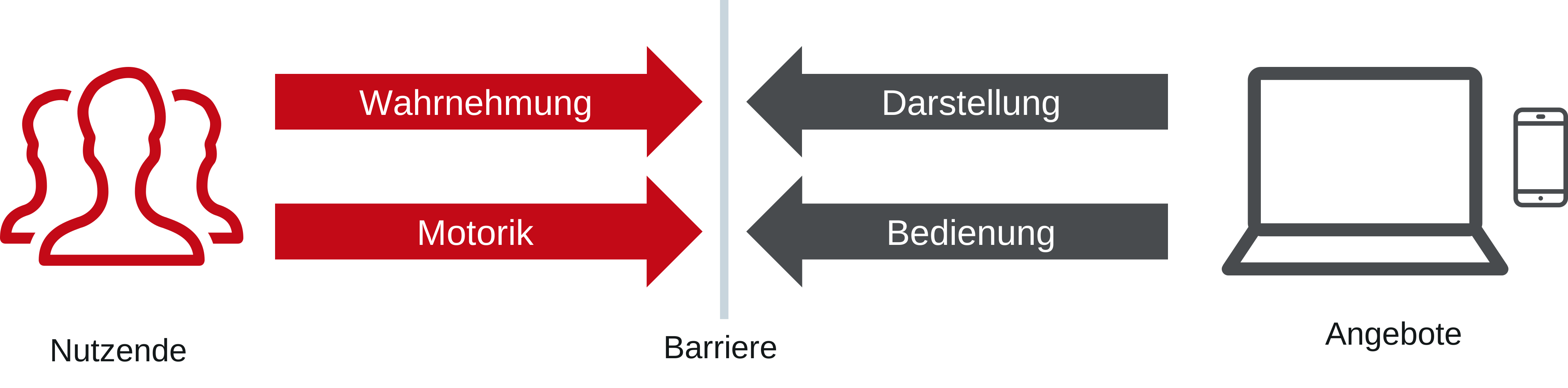
The digital world is constantly growing and has an impact on almost every area of life. It is therefore crucial that digital products are accessible to everyone – particularly people with disabilities. Digital accessibility means that websites, online shops and apps are designed in such a way that they can be used by everyone, regardless of their abilities, without undue difficulty and, in principle, independently.

Nadja Fecher
Accessibility Expert

What does digital accessibility mean? 

According to Section 4 of the Disability Equality Act (BGG), digital accessibility refers to the use of digital products by people with various disabilities without encountering barriers. Accessibility goes beyond purely technical usage: it ensures that all parts of a product – be it a website, an app or an online shop – are accessible and usable. An accessible product takes into account a wide range of needs and abilities and ensures that it can be used by as broad a group of users as possible. 

Who needs digital accessibility? 

First and foremost, it is people with disabilities who rely on accessible digital services. In Germany, there are around 7.9 million people with a recognised severe disability, which corresponds to around 10 per cent of the population. Furthermore, more than a third of people aged 18 and over have a condition that limits their everyday activities. 

However, accessibility is not only important for people with permanent disabilities, but also for those who are temporarily or situationally restricted. For example, a broken arm or a sudden illness can make it difficult to use digital devices. Everyday situations, such as using a mobile phone in bright sunlight or filling in a complex form under time pressure, also make digital accessibility relevant to each and every one of us. 

Why is digital accessibility so important? 

Accessibility is not just an issue for a ‘marginalised group’, but affects us all. When a digital product is designed to be accessible, it is not only people with disabilities who benefit. A good example is subtitles in videos, which are essential for deaf people but also benefit many other users – whether to learn a foreign language or to concentrate better on the content of a video. 

Furthermore, accessibility plays a crucial role in search engine optimisation (SEO). An accessible website that utilises text alternatives and a semantic page structure is ranked more highly by search engines and is therefore discoverable by a wider audience. 

Legal requirements and outlook 

In addition to the practical benefits, there are also an increasing number of legal requirements obliging companies to design their digital products to be accessible. Public bodies have long been required to comply with the provisions of the Accessibility Act. For the private sector, the Act on Strengthening Accessibility (BFSG) will come into force in June 2025. This means that companies must ensure the accessibility of their digital services not only for ethical and practical reasons, but also for legal reasons. 

Conclusion 

Digital accessibility is an essential component of an inclusive society. It ensures that everyone, regardless of their abilities, can participate equally in digital life. Furthermore, incorporating accessibility also offers benefits for all users and helps to ensure that products are more user-friendly, easier to find and more successful in the long term. Anyone who neglects digital accessibility when developing their products risks not only excluding a large group of users, but also suffering competitive disadvantages. 

Further information:

Digital accessibility

Nadja Fecher
Accessibility Expert

Nadja Fecher is an accessibility expert at Materna. With a background in user experience design and requirements engineering, she advises clients on the implementation of accessible digital solutions and checks websites for compliance with legal requirements.

Related articles

Blog
Digital Experience
25.08.2026
Design systems as the foundation of digital applications

Nowadays, digital products are rarely developed in isolation. Websites, apps, portals and service applications are all interconnected and must…

Read more
Blog
Digital Experience
30.06.2026
Tilting at windmills: Why UX isn’t AI prompting

These days, absolutely everything is supposed to offer a good user experience: the way I order a pizza, the way I hold my watch briefly over a shelf…

Read more
Blog
Digital Experience
02.06.2026
Why a good user experience is key to the success of digital products

A digital product is not automatically successful simply because it works from a technical point of view. What matters is whether people understand…

Read more
Blog
Digital Experience
21.05.2026
The path to an accessible terminal: implementation, legal considerations and opportunities

In the first part of this blog series, we explained how the Accessibility Enhancement Act (BFSG), which comes into force in 2025, obliges companies to…

Read more
Blog
Digital Experience
05.05.2026
Accessible self-service terminals: How the BFSG makes our everyday lives fairer and easier

Accessibility is a fundamental prerequisite for enabling people to participate in public life on an equal footing. Around 13 million people in Germany…

Read more
Blog
Digital Experience
21.04.2026
Managing IT costs in small and medium-sized enterprises: How a clear architecture creates transparency and cost-effectiveness

Rising IT costs coupled with increasing pressure to innovate – many medium-sized companies are currently facing precisely this dilemma. The challenge…

Read more
Blog
Digital Experience
11.03.2026
Hyper-personalisation: How do you design products that are constantly changing?

The digital world is undergoing a transformation. With the rise of artificial intelligence, it is not only the tools that designers use that are…

Read more
Blog
Digital Experience
24.02.2026
Pizza meets UX: The usability test dinner at Materna in Berlin

In mid-February, Materna hosted the Usability Test Dinner in Berlin. The event brings digital and analogue products together with real users – in a…

Read more
Short News
Digital Experience
Data & AI
Public Sector
11.12.2025
Chatbot technology

In the public sector, chatbots facilitate communication between members of the public and the authorities. The Cybercrime Co-ordination and Contact…

Read more
Blog
Verwaltung Digital
Digital Experience
Public Sector
26.08.2025
High-quality digital administration: DIN SPEC 66336 as a service standard for online services

The digitalisation of public administration is a key priority for modern state governance. The Online Access Act (OZG) established the legal framework…

Read more