When accessibility becomes the norm
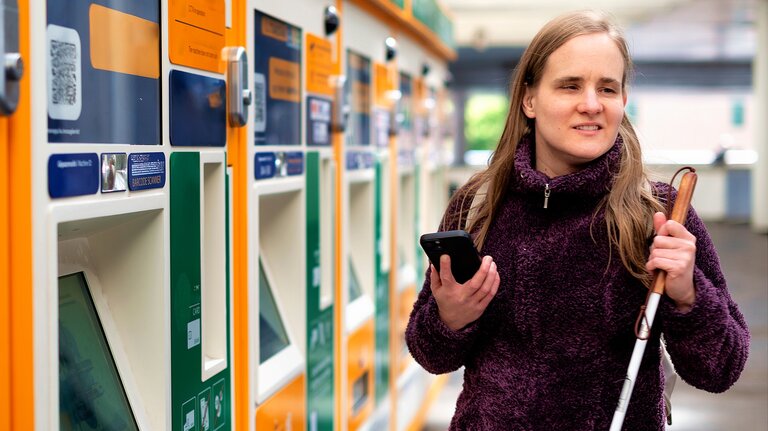
With the Accessibility Enhancement Act (BFSG), Germany is addressing this need and, for the first time, has required private companies to implement accessibility measures since 28 June 2025. Self-service terminals, such as ticket machines, play a crucial role in everyday life and are explicitly included among the products that must be designed to be accessible.
Accessibility in public spaces benefits everyone: requirements such as clear user guidance, audio support or flexible settings for contrast and brightness help everyone. Barriers often affect people without formal disabilities too – such as older people, users in a hurry or occasional users. Accessible self-service terminals therefore not only contribute to inclusion but also improve the overall accessibility and efficiency of services.
From ticket machines to check-in kiosks: these terminals fall under the BFSG
The following self-service terminals are covered by the BFSG:
as well as the following self-service terminals, provided they are intended for the provision of services covered by the BFSG:
- Cash machines
- Ticket machines
- Check-in machines
- interactive self-service terminals for providing information (with the exception of terminals that are installed as integral parts of vehicles, aircraft, ships or rail vehicles)
Operators and manufacturers must ensure that the equipment, software, instructions and documentation are all designed to be accessible.
Accessibility becomes mandatory: What modern terminals must achieve today
To ensure a self-service machine is accessible, it is essential to take into account the various user groups and their specific requirements. The European Standard 301 549 takes the diversity of user groups into account in its test procedures and is supplemented by further requirements under the BFSGV.
Requirements for blind users: audio, tactile feedback and orientation
Blind people require both audio output and tactile orientation aids to be able to use a ticket machine independently. In this regard, the BFSG, in conjunction with the BFSGV, sets out various requirements for audio output. For example, the volume and speed must be adjustable, and users must be guided reliably and clearly through the entire operation process.
It is equally important that the audio guidance can be started without visual assistance. This requires clearly distinguishable tactile controls so that users can locate the start mechanism using their sense of touch alone. Other control elements – such as buttons on PIN pads or navigation keys – must also be clearly distinguishable by touch and safe to operate. Physical tickets must also, where necessary, feature tactile markings if their orientation is relevant for further use.
Privacy protection is a key component of accessible design: for all audio output, a headphone socket must therefore be provided for blind users so that sensitive information can be played back discreetly.
Requirements for users with mobility impairments
Users with limited mobility must be able to reach and operate all the controls on a ticket machine without encountering physical barriers. To this end, the requirements specify fixed minimum and maximum heights for control elements. These also take into account potential obstacles, such as structural protrusions or bulges in the housing, and specify mandatory dimensions for knee and foot clearance, ensuring that the machine remains easy to use whether sitting or standing.
It must also be ensured that display content is clearly legible from a seated position, for example by wheelchair users. This means that displays must not be mounted too high or too low and must be positioned so that information is clearly visible when seated. An adjustable display height is ideal.
Safe and intuitive operating logic
Another key aspect concerns the amount of force required: operating the machine must not require more than 22.2 N of force. This limit ensures that even people with limited muscle strength can make inputs without significant physical effort.
Furthermore, control elements must always be designed in such a way that manual operation is as simple as possible. Ideally, an action should be triggered simply by touching the screen with a single finger, without the need for complex movements. This makes using the machine considerably easier for people with limited fine motor skills or impaired coordination.
When operated by touch, control elements should be designed so that they are not activated when pressed down, but only when the finger is released. Controls on electronic displays must be of a minimum size and maintain minimum spacing from neighbouring controls. This prevents functions from being triggered unintentionally and ensures that operation is reliable and controlled.
Use whilst seated and good display legibility
People with visual impairments rely on high contrast and sufficiently large fonts. This applies not only to the content on the electronic display, but also to all hardware labelling, such as signs and instructions on the casing of a ticket machine. The BFSGV also requires electronic displays to be designed in such a way that brightness, font sizes and contrast can be flexibly adjusted. This ensures that users can adapt the display to their individual needs and to specific situations, such as strong sunlight.
Flexibility and alternatives in use
It is also important that users are given sufficient time to make entries or read instructions before a process is automatically terminated or a message disappears. This is particularly beneficial for people with motor or cognitive impairments, who require more time to operate the equipment.
If a self-service terminal uses voice functions, a non-auditory alternative must always be available so that all users can fully understand the content, regardless of their hearing ability.
Accessible provision of information
In addition, information on the accessibility of both the terminal itself and the service provided via it must be available, e.g. on a website and, where possible, on the terminal itself. This information must also be available in an accessible format so that all users can access it without restriction.
In addition to the key requirements listed above, there are further specifications set out in the European standard EN 301 549, the BFSG and the BFSGV. All these specifications are taken into account and assessed during an accessibility test.
Read the next article to find out how businesses can implement accessible self-service terminals in practice, which legal requirements apply, and what opportunities this presents in terms of user-friendliness, inclusion and competitiveness.
Further information
The path to an accessible terminal: implementation, legal aspects and opportunities
Digital accessibility
Digital accessibility: How to ensure successful implementation
Find out more about our services in the field of digital accessibility.