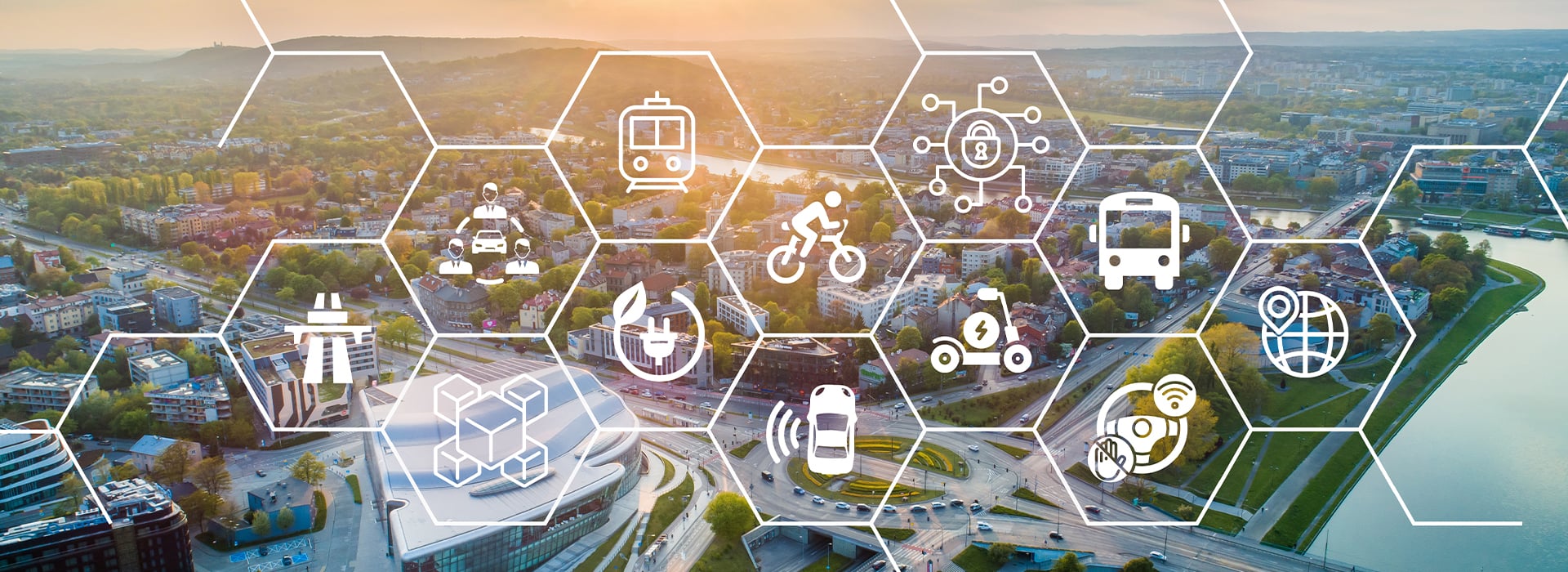
IT systems optimise traffic and mobility management

The secure and confident provision and use of transport data.

Services and infrastructure for improved traffic data exchange

People’s mobility in the 21st century is constantly increasing. The key factors for environmentally and socially sustainable mobility in the future are smart infrastructure planning and maintenance, as well as optimised traffic management. These factors are significantly enhanced by ensuring that traffic and mobility data is provided securely and independently, and that the data can be utilised whilst remaining protected. Materna is involved in numerous innovation projects for transport authorities, in which usage data is provided in a way that adds value. We provide specialist and technical concepts, software development and operational support.

Current projects in modern traffic and mobility management

From 2025, the new data platform to be developed by NRW.Mobidrom GmbH will process and aggregate mobility data across all modes of transport and make it available on a non-discriminatory basis. Materna is playing a key role in this pioneering project for North Rhine-Westphalia. The project remit encompasses the development, implementation and operation of the mobility data platform for the state of North Rhine-Westphalia.

The data and the services offered via the platform are aimed at local authorities, private and public transport operators, as well as research institutions and start-ups. With its centralised access point, the data platform represents an important addition to the mobility ecosystem and will enable so-called multi-modal mobility concepts. Existing data sources from the sectors of private motorised transport, buses and trains, cycling and scooter-sharing, as well as mobility providers, will be interconnected with one another and with nationwide platforms.

Materna’s responsibilities include, in particular, the development of the system architecture (using open-source technologies such as Kubernetes), the establishment of the operational platform, and the development of the self-service portal for the platform’s future users. The Materna consortium comprises TraffGo Road, a company within the Materna Group specialising in mobility, Trafficon – Traffic Consultants GmbH and Q_PERIOR AG. 

The federal government’s Autobahn GmbH is equipping its nine traffic control centres with a modern, modular operating system (AutobahnOS). Materna and its subsidiary TraffGo Road played a key role in the design and development of AutobahnOS and are also responsible for operating the platform. AutobahnOS was developed using a modern service-oriented architecture.

One of the most important components is the integration platform implemented by Materna, which ensures that the applications work together seamlessly. The system architecture of the integration platform is based on container technology, a Kubernetes platform and open-source components. In the interests of data efficiency, a uniform, cross-application data model was developed for AutobahnOS, which is shared by all applications running on it. For example, almost all applications in a traffic control centre require an initial supply of geodata. This data is made available centrally and in a consistent format via the platform. Connected applications subscribe to the data and process it according to their specific purpose. Information obtained in this way can be made available to other users. The integration platform is standardised, easily scalable and expandable to accommodate new applications, which are also deployed in containers. To date, more than 100 applications have been integrated onto the platform, and up to 100 million data records are processed daily.

Among the new applications is NORA (Network Operation and Road Application), the existing system for planning dynamic signposts and information boards (for controlling the dWiStA boards). NORA is the key element in the automated control of traffic on motorways. NORA calculates alternative route recommendations and immediately transmits these to the relevant signs on the motorway. NORA also makes alternative route recommendations available free of charge on platforms such as the federal government’s Mobilithek and the Mobility Data Space. Materna is porting the project to the integration platform as part of its development and operational services.

Another application is the MIA roadworks management system. Together with the Hamburg-based company WPS, TraffGo Road is implementing the roadworks management system for Autobahn GmbH. The tool covers work site planning, the organisation of work sites and the sharing of roadworks information with other applications, such as the Autobahn app, the GST tool or the MDM. This allows details of work sites to be visualised, such as the time periods, length, speed limits and traffic management measures. In future, all roadworks will be managed via a single system operated by the Federal Motorway Authority.


The Federal Motorway Company (Autobahn GmbH) has established the organisational and technical framework for efficient, Germany-wide traffic management. Traffic control centres across Germany have been networked, and traffic management and control have been optimised through centralised coordination. The benefits include coordinated planning of roadworks, dynamic traffic diversion via alternative routes in the event of disruptions, and the provision of up-to-date, consistent information.

Materna supported this innovation project with concept development and project management. Together with TraffGo Road, Materna developed the German Traffic Control Centre (VZD) for the Federal Motorway Company (Autobahn GmbH), which now coordinates traffic management nationwide.

Behind the Smart Delivery and Loading Zones (SmaLa) project lies a virtual booking system for delivery traffic, which enables courier, express and parcel service providers to reserve delivery and loading zones in the city. The SmaLa project, run by our subsidiary TraffGo Road, has been honoured with the German Innovation Award. When 80 per cent of the zones are occupied by illegally parked vehicles, delivery drivers spend a long time searching for alternative parking spaces or end up double-parking. This results in increased CO₂ emissions, traffic congestion and a higher risk of accidents, particularly for cyclists. SmaLa was developed in response to the growing prevalence of online retail and the resulting increase in delivery traffic. The next phase involves incorporating bus stops into the system as ‘pick-up points’, thereby enabling even more data to be collated.

Many IT services would not be possible without cloud services. GAIA-X is a European cloud architecture tailored to the needs of organisations in the EU, designed to simplify compliance with European data protection and security standards. GAIA-X establishes a reference architecture that any cloud provider can implement. 

Furthermore, it will be widely usable by public authorities to offer data-driven services. The model aims to create secure data spaces through which companies across various sectors can manage their data independently. GAIA-X thus represents a key element in the ongoing digitalisation of many areas of life. Only when it is possible to transform data into information using trustworthy technologies can the full potential of digital transformation be realised. 

Materna is involved in several GAIA-X projects, including those focusing on the use of transport data. One such project is GAIA-X 4 moveID. It brings together mobility services from both the private and public sectors. Areas of application include smart parking, smart charging for electric vehicles and the establishment of dynamic low-emission zones in urban areas. Practical implementation is being tested in collaboration with partners. It is a sub-project of the European initiative GAIA-X 4 Future Mobility. The organisation GAIA-X AISBL has awarded the GAIA-X 4 moveID project the status of ‘Lighthouse Project’.

Mobility is increasingly adapting to individual needs. What is needed is real-time data on traffic, the needs of those involved and the availability of services based on this data. The secure and autonomous provision, as well as the protected utilisation, of this data in distributed systems are crucial factors for the success of tomorrow’s mobility. The Mobility Data Space (MDS) brings together companies, organisations and institutions: those who wish to monetise their data assets and those who require data for innovative mobility solutions. To ensure sovereign data exchange, Materna utilises the Mobility Data Space and integrates its own client projects into it.

Our services for data-driven traffic management

  • Development of data hubs linking a wide variety of data sources and integrating them
  • Creation of web GIS-based traffic information portals for the user-friendly presentation and analysis of data
  • Creation of modern, high-availability traffic control centres integrated with sensor and actuator technology, e.g. for the purpose of collecting, analysing and distributing traffic data to optimise processes and reduce CO₂ emissions
  • Conducting AI-based big data analyses, including those based on floating car data, to evaluate traffic management measures
  • Simplifying parking through the digitalisation of infrastructure to enable optimal routing and cashless payment for parking: introduction and operation of a cross-provider smart parking platform in over 350 local authorities
  • Establishment, management and operation of smart charging zones to prevent double-parking: development of a mobile app for booking smart charging zones for courier, express and parcel delivery services 

Our key areas of focus for smart transport data 

Data Analytics


Intelligent traffic control, simulation and forecasting methods 


Data Governance


Sovereign data exchange at federal and state level 


Data Engineering


Dynamic collection and provision of traffic data


Data Infrastructure


Networked transport control centres and infrastructure 


TraffGo Road. Our subsidiary specialising in mobility solutions.  

Modern mobility and transport concepts require a vast amount of data from a wide variety of sources. Intelligent IT solutions are used to process, analyse and visualise this wealth of data – for a future-proof transport system and a sustainable transport transition. That is the mission of TraffGo Road, our subsidiary specialising in mobility solutions.  

Visit TraffGo Road now

This is of interest to other users

The sovereign cloud

Cloud-based IT services – whilst long established as the norm in the private sector, they must meet stricter regulatory requirements in the public sector. Development and implementation times are longer – and there are many reasons for this. The public sector has also long recognised that the cloud is the technology of choice for the future. Materna Monitor shows how the gap between aspiration and reality can be bridged – with Journey2Cloud™ Public. 

> Find out more

Greater business success through more data

Healthcare, mobility, environmental protection and disaster management are some of the most important societal challenges we face today. The rapid growth in data resulting from digitalisation provides the raw material needed to develop solutions to these challenges. What is currently lacking, however, is the infrastructure required to manage this valuable resource responsibly. 

> Find out more

Please feel free to contact us

Potrait von Ansprechpartner Jan Siepmann

Jan von Dombois
Key Account Manager