Architecture of the future

Efficient Enterprise Architecture Management.

Enterprise architecture management for innovative business strategies

In a dynamic business world, it is crucial for companies to strategically design and manage their enterprise architecture. Enterprise Architecture Management (EAM) focuses on the structuring and optimisation of business processes, data, applications and infrastructures. We will introduce you to the four principles of EAM that are particularly relevant: Identifying redundancies, avoiding heterogeneity, reusability and ensuring consistency.

Four Principles of EAM - Holistic solutions for your future-proof company

There are often numerous unknown or unconscious dependencies and redundancies between the business and the IT architecture.

Identifying redundancies is a central principle of EAM, which aims to recognise and eliminate duplicate or superfluous elements within the enterprise architecture. This process not only enables a more efficient use of resources, but also minimises potential sources of error. By systematically analysing processes, data and applications, SMEs can identify unnecessary duplicates and deploy their resources in a more targeted manner.

A homogeneous IT landscape enables and improves the management, integration and maintenance of systems and technologies.

Avoiding heterogeneity is another key principle of EAM. It aims to minimise the diversity of technologies, platforms and systems within the corporate architecture. Medium-sized companies benefit from this by consolidating their IT landscape and reducing complexity. This not only promotes scalability, but also facilitates the maintenance and updating of systems, which leads to greater efficiency and cost-effectiveness overall. Furthermore, the approach enables an efficient approach to optimising cyber resilience by allowing indicators that affect the security and integrity of systems and their components to be processed more quickly.

Actively promoting the recurring use of components, processes and technologies within the organisation's IT landscape.

Promoting reusability is a principle that aims to utilise existing resources such as applications or data models multiple times. This not only contributes to cost savings, but also accelerates the development of new products or services. Medium-sized companies can use standardised, reusable components to increase their innovative capacity and at the same time shorten their time-to-market. Explicitly justified deviations from standards, which are necessary due to commercial or data protection aspects, can be managed transparently in this way.

The avoidance of contradictory approaches, a high degree of consistency and technological harmony are drivers and enablers.

The principle of architectural consistency refers to ensuring that all parts of the enterprise architecture harmonise with each other and are complete. This is crucial in order to avoid inconsistencies, data errors or process breaks. With the help of precise guidelines and standards, this principle ensures a homogeneous and well-coordinated enterprise architecture. Flexible reporting orientated towards the needs of stakeholders ensures transparency and promotes the informative value of the architecture, thereby enabling control and innovation.

Mindset Call

The comparison

In an EAM mindset discussion, we create a solid basis for effective collaboration in the area of enterprise architecture management. Together, we will discuss the challenges you face and which goals are in focus. You will gain initial insights into our approach and procedures, which will provide you with a good basis for decision-making.

The Bridge Builder

Practice right from the start

Our workshop "The Bridge Builder" provides a comprehensive introduction to our Enterprise Architecture Management methods. We place particular emphasis on the initial collaboration between the participants and our team. Through interactive workshops, we teach both the theoretical foundations and the practical implementation. As a result, you will receive an MVP (Minimum Viable Product) Service Block Identification, which enables you to identify the most important service elements. In addition, we teach methods for joint work and show initial results based on the identified service blocks. These results serve as a basis for deciding on further collaboration in order to further optimise the enterprise architecture.

EAM Approach

Simplifying complexities

Enterprise Architecture Management forms the foundation for the stability of a company. Materna offers a complete EAM approach that supports companies in every situation with pinpoint accuracy. Our EAM service portfolio focuses on the essential aspects of business and IT strategy. We place particular emphasis on optimising business areas and processes, securing business and IT planning and budgets, improved and secure decision-making while taking risk reduction into account and identifying opportunities.

EAM Portfolio

EAM portfolio according to ArchiMate Colours

Partnership with BOC Group

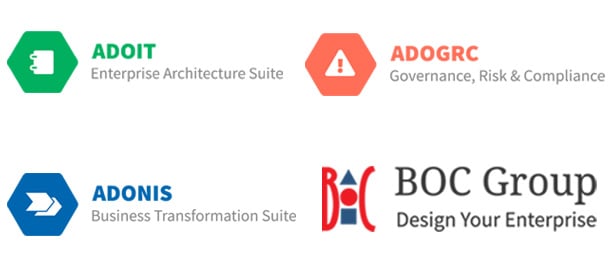
Materna has strategically positioned itself for the future with its partnership with BOC. The BOC Group develops and markets holistic and state-of-the-art enterprise modelling software for effective and comprehensive corporate management in the digital age. These products are the Business Process Management Suite ADONIS, the Enterprise Architecture Suite ADOIT and ADOGRC for Governance, Risk & Compliance.

Open for you and your ecosystem

We rely on architecture expertise that empowers you and your teams. To this end, we are happy to utilise the toolchain that you are already using - and work with you to find out how your ecosystem can develop further. Our decades of experience from the mix and successful interaction of different tool constellations ensure that we can focus on the main challenge: Your architecture. Our experience gives us expertise and insights into other leading tools such as Alfabet, Ardoq and ABACUS, which we are constantly developing further.

Please feel free to contact us

Potrait von Ansprechpartner David Hohl

David Hohl
Principal Enterprise Architect

Philipp Schneidenbach
Principal Enterprise Architect