Digitalisation in SMEs – five areas that make all the difference.

What matters now: direction, focus and concrete steps. As a medium-sized business, you’ll find what’s truly relevant to you here.

Digitalisation is a top priority. We make it happen. 

As a business leader in the SME sector, you are under pressure: the pace of innovation, skills shortages, disruptive business models and complex markets all demand swift yet sustainable solutions. Digitalisation is a key driver of resilience, efficiency, competitiveness and growth. As a company with our own experience of transformation and a tradition rooted in the SME sector, we know what matters – and we advise on an equal footing and with a practical approach. We understand SMEs and are ranked number one among Germany’s top IT companies serving the SME sector. 

Webcast series: ‘SMEs – going digital now.’

Our webcast series has now been successfully concluded.
Over the course of five sessions, experts with hands-on experience demonstrated how SMEs can successfully tackle current digitalisation issues and make targeted use of modern technologies. The focus was on practical insights, innovative approaches and concrete experiences from various areas of business.

Watch the recordings

Ready for the next level – digitally, strategically, entrepreneurially.  

Those who further develop their IT and process landscapes, make the most of their data and set the right digital priorities create scope for growth and stability in uncertain times. Are you also faced with the question: Where to start? What really makes a difference? And how do you remain capable of taking action without taking on too much? This is where we, as a family-run business with a long tradition, come in: we make digitalisation understandable, tangible and achievable. With specific areas for action, practical insights and a clear goal: to prepare small and medium-sized enterprises for the next stage of their development – digitally, strategically and entrepreneurially.  

“Digitalisation is not merely a technical task. It is a strategic step towards the future – particularly for small and medium-sized enterprises. We make it understandable and achievable, and work alongside you as equals.” 

Michael Hagedorn, CEO, Materna Group 

Tradition with a future – built on corporate responsibility 

Materna was founded over 45 years ago by the Materna and an de Meulen families – with the aim of making technology accessible in a responsible manner. Today, the second generation is actively involved in the company and is helping to shape its transformation. Despite our growth to over 4,500 employees worldwide, it is still values such as reliability, quality, customer focus and long-term thinking that guide our actions. We combine this continuity and experience with innovative strength – and support companies that wish to forge their own path into the digital future. The fact that we have been voted number 1 among Germany’s top IT SMEs (Markt und Mittelstand) is a testament to this. 

Structural challenges

Five areas of action for a sustainable SME sector

Our five areas of focus are deliberately interlinked: cyber security forms the starting point. Without security, there is no foundation for any further digital development. Artificial intelligence acts as a strategic and operational driver, but requires robust structures. That is why we are focusing on IT and enterprise architecture as the connecting element that brings security and innovation together. Building on this, digital platforms are emerging – for example in Enterprise Service Management – which efficiently orchestrate services and make them scalable. Finally, the cloud provides the technological foundation for all of this – flexible, secure and future-proof. This creates a holistic approach that brings technologies together, generates real added value and is tailored to the realities of medium-sized industrial companies.

Digital transformation creates new opportunities – but also new risks. The more processes are interconnected, data centralised and systems automated, the more vulnerable they become. For medium-sized industrial companies, this means that cyber security is not a peripheral technical issue, but a business-critical success factor.

At the same time, external pressure is mounting: 

  • cyberattacks are increasing in frequency and complexity,
  • regulatory requirements such as NIS2 or DORA demand structural security measures,
  • and customers and partners expect reliable evidence of IT security throughout the supply chain. 

Many medium-sized organisations are inadequately prepared: 

  • There is a lack of systematic risk assessments,
  • security measures are ad hoc rather than holistic,
  • and the protection of business-critical services is not sufficiently geared towards failure scenarios. 

We view cyber security as an integral part of modern IT and enterprise architecture – and as a prerequisite for sustainable growth and digital resilience. 

Our focus is on: 

  • the preventative protection of your systems and data,
  • structured security strategies with clear lines of responsibility,
  • and the ability to remain operational even in the event of a crisis (business continuity management). 

Whether it’s technical safeguards, security-by-design, security architectures or awareness campaigns: we help you to secure your organisation holistically – tailored to your risks, your business model and your digital maturity. 

Our services in the field of cyber security and resilience – holistic, practical and effective 

Security is not a static state – but an ongoing process. We support medium-sized enterprises in strategically establishing their IT security, meeting regulatory requirements and making their organisation resilient in the long term. 

Information Security Management System (ISMS) 

With an ISMS based on established standards (e.g. ISO 27001), we take a holistic view of cyber security – as an interplay of technology, organisation and governance. At the same time, this enables you to meet key requirements under NIS2, KRITIS and similar regulations. 

Cybersecurity Gap Analysis 

We analyse the current maturity level of your information security – and identify specific areas where action is needed for your future security strategy. Ideal as a starting point for a targeted roadmap. 

Business Continuity Management (BCM) 

Through business impact analyses, contingency plans, crisis communication plans and realistic exercises, we help you build organisational and technical resilience – before it really matters. 

Security Monitoring & SIEM Consultancy 

We support you in setting up effective security monitoring – from requirements analysis and tool selection (e.g. SIEM systems) through to the definition of use cases, log sources, detection rules and architectures. 

Platform-Based Resilience – Integrating Cyber Security and Service Platforms 

Another advantage is that many of the service platforms we implement as part of the digitalisation of business and service processes – including BMC Helix, ServiceNow, Atlassian and OpenText – offer powerful modules for implementing business continuity management, crisis response and security workflows. 

This creates a holistic approach: 

  • BCM plans are managed centrally
  • Emergency processes can be automated
  • Crisis communication can be managed via workflows
  • Security incidents can be recorded, prioritised and tracked in a structured manner 

This brings us full circle: what begins in the platform has an impact right through to the resilience strategy. 

Whether it’s predictive maintenance, intelligent quality control or automated customer services: artificial intelligence opens up enormous potential for medium-sized industrial businesses – provided that data, processes and objectives work together effectively.  

Many companies already collect large volumes of machine, production or service data – yet the economic benefits often remain untapped. This is where AI comes in: it recognises patterns, automates decisions and reveals complex interrelationships – faster and more accurately than humans could. 

However, the successful implementation of AI does not begin with the technology, but with the question: which specific challenges can be better solved using data? 

That is why, in addition to use cases, a well-thought-out data strategy, clear governance structures and an understanding of where AI creates real added value – and where it does not – are required. 

As a medium-sized IT partner, we support you in integrating AI into your organisation step by step, in a practical and effective manner – not just by introducing tools, but by creating value. 

Our services in the field of AI and data – strategically sound, technologically feasible 

We help medium-sized companies to derive real added value from data – from strategy right through to technical implementation. 

In the field of artificial intelligence, we develop: 

  • AI agents for the autonomous processing of standardised tasks
  • AI assistants that support staff with decision-making and processes
  • Customised AI models, trained on sector-specific data
  • AI strategies that intelligently integrate technology, organisation and governance 

In the field of data and analytics, we advise you on: 

  • Data analysis and visualisation to support decision-making
  • Data engineering for the preparation, integration and scaling of data sources
  • Data management that ensures quality, security and availability
  • Data rooms that enable cross-organisational data exchange
  • Data strategies that effectively link technology and business objectives 

Our approach: We do not view AI and data in isolation – but as the key to the digital transformation of your business. 

Expanding IT environments, increasing complexity and mounting economic pressure are making it ever more difficult for medium-sized companies to manage their IT in a reliable, predictable and cost-effective manner. The key question is: How can an IT structure be created that remains manageable, is economically viable and supports the business in the long term?

Materna shows you how Enterprise Architecture Management (EAM), as a strategic tool, creates transparency regarding costs, dependencies and risks, thereby enabling well-informed decisions. Modern architectural principles help to reduce complexity, increase resilience and improve operational planning within IT controlling. Build, step by step, a sustainable and economically stable IT landscape as the foundation for innovation, agility and sustainable growth.

Our services in the field of IT architecture: bridging the gap between strategy and financial management

We support medium-sized enterprises in developing their IT architecture in a structured, cost-effective and future-proof manner, from strategic vision to operational management. In doing so, we combine methodical Enterprise Architecture Management with clear transparency regarding costs, dependencies and risks.

Enterprise Architecture Management (EAM)

With our EAM approach, we strategically manage digital transformation and consistently align IT and business objectives.

Our services:

  • Capability and Business Mapping
  • Vision and Governance
  • Architecture and modularisation
  • Transformation roadmaps
  • Governance and Responsibilities
  • Infrastructure Integration within the Architectural Framework

Cost Management, Transparency and Operational IT Controlling

Our approach reveals hidden cost drivers, improves operational planning and strengthens the financial resilience of IT.

Our services:

  • Analysis of hidden cost drivers
  • EAM-based Total Cost of Ownership (TCO) perspective
  • Risk and dependency analysis
  • Structured IT controlling
  • Economic architecture assessments
  • Clear cost responsibilities
  • Resilience and stability assessment

IT Infrastructure Architecture 

We analyse your existing infrastructure, benchmark it against established reference architectures (e.g. IT4IT) and develop concrete infrastructure strategies – including cloud migration, modernisation and security concepts. Our services: 

  • Analysis and assessment of the IT infrastructure
  • Benchmarking against IT4IT etc.
  • Development of modern infrastructure architectures
  • Concepts for cloud migration (including hybrid and multi-cloud)
  • Consolidation of data centres
  • Implementation of IT compliance and security requirements
  • Support with disaster recovery and contingency planning 

Our aim: an economically transparent, operationally stable and future-proof IT architecture that strengthens your business in the long term.

In many medium-sized industrial companies, service processes have evolved over the years – but have rarely been integrated. A variety of tools, in-house solutions and a lack of standards lead to workflows with frequent changes in media, a lack of transparency and increasing administrative burden. 

Service management platforms offer the opportunity to organise internal and external services efficiently, transparently and scalably – from IT and maintenance through to after-sales, HR and procurement. Whether as a customer service portal, a digital service centre for field staff or a central workflow system, digital platforms make it possible to digitally expand existing business operations and open them up to new business models. 

It is particularly during international rollouts that it becomes clear what is missing: 

  • standardised platforms,
  • clear lines of responsibility,
  • simple, user-friendly access to internal services – across national borders. 

Service management platforms such as Atlassian, BMC Helix, OpenText or ServiceNow offer the opportunity to standardise end-to-end service processes, enable self-service, utilise AI agents for automation and establish global governance structures – all in a modular, scalable and adaptable way that suits the realities of the SME sector.  

Analysts at ISG position Materna as a market leader in the mid-market segment – with particular strength in the implementation of complex yet economically viable platform strategies. 

Typical challenges we help you solve: 

  • Fragmented processes and media breaks: Each department works with its own forms and tools – we create integrated workflows.
  • Lack of transparency and information overload: Unclear services, technical portals, confusing tools – we design understandable, role-based service portals.
  • High manual effort and rising maintenance costs: Emails and Excel instead of automation – we migrate, consolidate and simplify.
  • No control, no KPIs: without data, there’s no control – we create platforms with transparency, metrics and scope for optimisation.
  • Lack of resources for complex in-house projects: That is why we deliver turnkey platform solutions that quickly create added value – without lengthy project timelines.
  • Missed opportunities due to a lack of automation and new technologies: Many platforms fail to live up to their potential – we integrate AI-powered agents, digital assistants and intelligent automation to make services smarter, faster and more scalable. 

In doing so, we focus not only on efficiency and scalability – but also on digital sovereignty: through hosting within the EU, GDPR-compliant operating models and the option to integrate sovereign cloud providers such as STACKIT or IONOS. 

Digital platforms are the key to developing organisations in a way that makes them future-proof, automated, internationally manageable and AI-based. And, in doing so, to rethink their own business models. 

Our approach: we design platforms from a services perspective – not a tools perspective 

Digital platforms do not realise their full potential through technology alone – but through clear services, well-thought-out processes and a genuine user-centred approach. That is why, at Materna, we take a tool-agnostic approach that is guided by your requirements – not by software specifications. 

What sets us apart: 

  • We place users and service processes at the centre – with a focus on roles, workflows and specific usage scenarios.
  • Platforms are designed and implemented to integrate seamlessly into your existing system and process landscape.
  • Whether it’s IT, HR, facilities or field service: we view platforms as enablers for automation, transparency and controllability – not as an end in themselves.
  • Where required, we deliver turnkey, AI-supported platform solutions that deliver rapid results and scale with your business over the long term.
  • Our solutions are AI-enabled on request, expertly managed and modularly scalable on an international basis. 

Materna works with leading platform providers such as ServiceNow, BMC Helix, Atlassian and OpenText – combining in-depth technological expertise with many years of consultancy experience in the industrial SME sector. 

Our goal: platform solutions that deliver results – integrated, cost-effective and future-proof. 

Cloud technologies are far more than just an IT issue. They are a strategic lever for medium-sized industrial companies to drive innovation, harness AI applications and implement new business models. 

After all, only those with a flexible, scalable and data-sovereign IT infrastructure can rapidly develop digital services, manage global roll-outs and, at the same time, handle growing volumes of data intelligently. 

Cloud transformation forms the foundation for this: it decouples IT from rigid structures, creates new scope for development teams and makes companies adaptable technologically, organisationally and economically. 

For medium-sized industrial companies in particular, it is essential to take data sovereignty and compliance into account – whether when handling sensitive production data, selecting suitable cloud platforms or integrating existing systems. 

We support you with our experience, technological expertise and sector-specific know-how – from cloud strategy through migration to governance. So that your cloud is not only available, but also delivers real results. 

However, not every cloud is suitable for every business: sovereignty, data protection and regulatory requirements play a central role, particularly when dealing with sensitive data or in an international context. That is why we focus on sovereign cloud concepts that are not only technologically scalable but also legally and strategically secure. Whether with European providers such as STACKIT or hyperscaler integrations such as AWS, Azure and Google Cloud with a governance layer: we develop cloud architectures that suit your organisation and grow with it.

Our cloud services – from strategy to operations 

The cloud is not an end in itself, but a catalyst for digitalisation, AI and new business models. We provide comprehensive support to medium-sized enterprises throughout their cloud transformation: in a structured, confident and tried-and-tested manner.

Strategy and change: thinking of the cloud as a business enabler

Together, we define your vision, develop a viable business case and establish clear frameworks for governance, security and autonomy. This creates a roadmap that is technology- and people-centred and engages the entire organisation.

Platforms: Creating a scalable foundation 

We build secure, efficient and automated cloud platforms using landing zones, platform engineering and integration with your service management. The result: a technical foundation that accelerates development, keeps costs under control and operates reliably.

Cloud-native development and migration: Developing new solutions, migrating existing ones sensibly 

Whether you’re starting from scratch or working with an established IT infrastructure, we support you in developing new, cloud-native solutions as well as in the pragmatic migration of existing systems. From ‘lift-and-shift’ to complete modernisation – and always with the right level of change.

Optimisation & Continuous Improvement: Getting more out of the cloud – sustainably and effectively 

We continuously improve the performance, cost structure and sustainability of your cloud landscape. This enables you to remain competitive and benefit in the long term from the innovation cycles of cloud providers.

Further resources for you to download

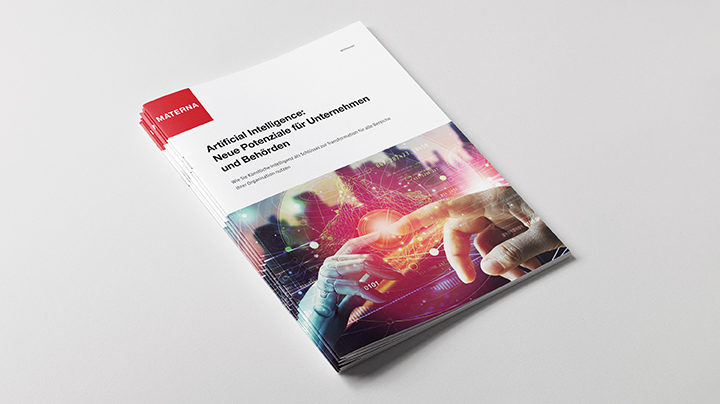
Get started straight away with our AI white paper

White paper: ‘How to use artificial intelligence as the key to transformation across all areas of your organisation’

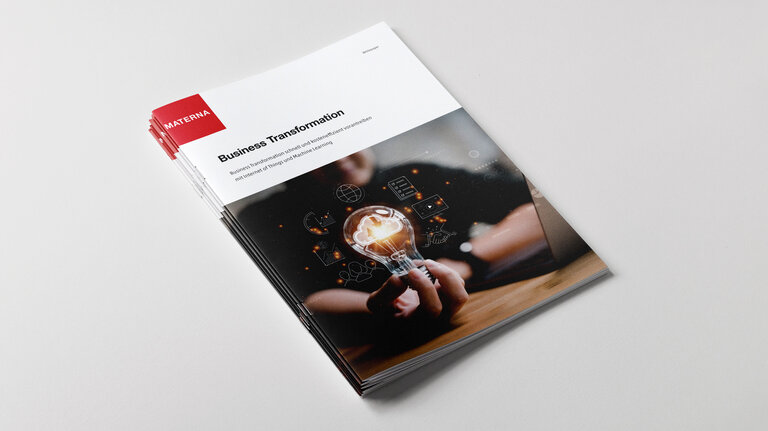
White Paper: Business Transformation

White paper: ‘Driving business transformation quickly and cost-effectively.’

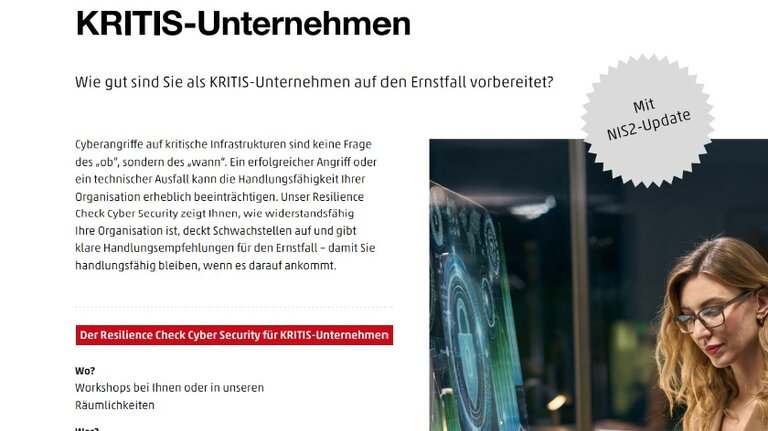
Cyber Security Resilience Check

Find out more about the “Resilience Check Cyber Security” OnePager now.

Further reading

Artificial Intelligence

Artificial intelligence in action: smart solutions for tomorrow, delivered today

Data and Analytics

Holistic strategies for data-driven companies

Regulatory framework

Regulation as a strategic lever for resilience

Human Firewall

Human Firewall: The human factor as the key to resilience

FAQ – Digitalisation in medium-sized industrial enterprises

NIS2 requires many industrial companies to implement structural measures to safeguard their IT security. We can help you check whether you are affected – and how to ensure you are compliant. 

Typical areas of application include predictive maintenance, quality assurance, document processing, and intelligent assistance and agent systems – all of which deliver direct added value in day-to-day business operations. 

With a phased cloud strategy that takes existing systems into account, enables hybrid scenarios and keeps governance, security and costs under control. 

Service platforms such as ServiceNow or BMC Helix help to centrally manage and automate internal services (e.g. IT, HR, facilities) and make them scalable on an international level. 

It reduces complexity, increases agility and enables the integration of new technologies such as cloud computing and AI – step by step and in line with your business processes. 

Through a structured information security management system (ISMS), continuous monitoring, clear lines of responsibility and contingency plans – including those supported by tools. 

Platforms such as BMC Helix, ServiceNow, OpenText and Atlassian – each of which can be used on a modular basis, integrated as a turnkey solution and scaled to suit medium-sized businesses. 

We start with a use case, analyse your data landscape and work with you to develop an AI roadmap – one that is pragmatic, data-driven and tailored to your business processes. 

With centralised service platforms, a global role model, self-service options and a platform-based approach that combines governance, processes and scalability. 

It creates new value – for example, through digital services, platform-based offerings, data-driven decisions or process automation throughout the supply chain. 

AI assistants support people with specific tasks – for example, by providing suggestions, draft texts or summaries. They only act when prompted and remain within the direct user context (e.g. chatbots, email summaries, co-pilots in tools). AI agents go one step further: they act autonomously within a clearly defined framework and can plan, prioritise and carry out tasks independently – for example, creating a ticket, retrieving data, preparing decisions or triggering workflows. In doing so, they assume responsibility for processes – often embedded in platforms such as ServiceNow or BMC Helix. 

EAM (Enterprise Architecture Management) deals with the strategic planning and management of an organisation’s entire IT landscape – spanning systems, processes, data and technologies. ITSM (IT Service Management), on the other hand, focuses on the operational delivery and quality of IT services, such as ticketing, change processes or service catalogues. 

‘Cloud-native’ means that an application has been developed from the ground up for the cloud – for example, it uses microservices, containers and elastic scaling. ‘Cloud-enabled’ means that an existing application has been retrofitted for cloud operation, but is still based on older architectures. 

A use case describes a specific scenario – that is, an objective to be supported by technology (e.g. ‘predictive maintenance’). A capability describes a capacity that a company needs in order to achieve its business objectives (e.g. ‘predictive maintenance planning’ as an organisational capability). In short: Use Case = What is to be achieved? / Capability = What must be possible to achieve this? 

Digitalisation refers to the technical transition from analogue processes to digital solutions. Digital transformation goes further – it encompasses changes to business models, culture, organisation and market dynamics. In short: digitalisation changes processes – transformation changes the organisation. 

A service portal is a central interface through which users access services – for example, to submit applications, raise tickets or place orders. Self-service refers to the actual ability to carry out a service independently and without assistance. In short: the portal is the entry point – self-service is what becomes possible once you’re inside. 

Please feel free to get in touch.

Would you like to know what this would look like for your business in practice? Let’s have a chat. 

Ansprechpartnerin Christine Siepe

Christine Siepe
Teamleitung Business Marketing