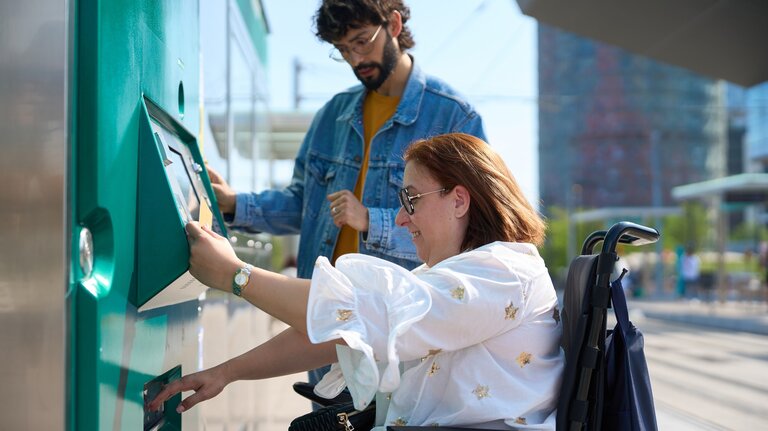
The path to an accessible terminal: the key steps
In addition to detailed findings on barriers, the inspection report contains specific recommendations for action and proposed solutions aimed at systematically removing existing barriers. Furthermore, it also identifies aspects which, whilst generally complying with legal requirements, still have room for improvement in terms of practical use by people with disabilities. The assessment therefore serves not only to establish compliance, but also to drive continuous quality improvement towards a truly usable and inclusive design.
Following the initial assessment, an accompanying consultancy process may take place, during which individual design stages and technical decisions are continuously reviewed and optimised with regard to accessibility. This iterative approach ensures that potential barriers and poor design choices are avoided or rectified at an early stage.
At the end of the development process, a final follow-up test can be carried out. This serves to verify the improvements achieved and to conclusively confirm the self-service terminal’s compliance with accessibility requirements. This ensures that the finished product not only formally complies with the specifications but can also be fully utilised in practice by people with various disabilities.
The Materna Centre of Excellence for Digital Accessibility offers this service. Two ticket machines have already been assessed for Frankfurt Transport Authority (VGF) in accordance with the BFSG. This makes Materna one of the first service providers in Germany to be actively assessing self-service terminals.
The legal situation – an overview
The BFSG, the BFSGV and European Standard 301 549
The Accessibility Enhancement Act (BFSG) transposes EU Directive 2019/882 (European Accessibility Act) into German law. For the first time, private sector operators are also obliged to meet accessibility requirements. The aim is to ensure that people with disabilities can use products and services independently. This promotes equal participation in social life.
The Accessibility Strengthening Act Ordinance (BFSGV) implements Annex I of the EU Directive. It contains specific technical requirements and refers to the state of the art. The European Standard EN 301 549 (currently version 3.2.1) is the relevant standard. The future version 4.1.0 is currently available as a draft and is due to come into force in 2026.
Deadlines and transitional provisions
The BFSG has been in force and binding for all affected products and services since 28 June 2025. This also includes self-service terminals such as cash machines, payment terminals, ticket machines, check-in machines and information terminals.
For products that were already in use prior to this date, transitional periods apply until 27 June 2030. Furthermore, self-service terminals may continue to be used until the end of their economic service life – but for no longer than 15 years after they were first put into service.
It is also important to note that sanctions may be imposed in the event of non-compliance or inadequate implementation. These include orders to rectify non-compliance, restrictions on provision, fines or, in extreme cases, a ban on distribution. This makes it clear that compliance with the deadlines is not only a legal obligation but also a key component of risk management.
Accessibility pays off – set the right course now
The accessible design of self-service terminals is now a legal obligation, a business opportunity and an important contribution to a positive corporate image. Around 13 million people with disabilities live in Germany – a large and significant target group.
The requirements will become binding from 28 June 2025. Organisations should make active use of the transition periods and take early action. It is advisable to seek advice in good time and to test both hardware and software under real-world usage conditions.
Materna provides support in designing self-service terminals that are accessible, user-friendly and compliant with the law – from analysis and consultancy through to the final compliance test.
Further information
Accessible self-service terminals: How the BFSG makes our everyday lives fairer and simpler
Digital accessibility
Digital accessibility: How to ensure successful implementation
Find out more about our services in the field of digital accessibility.