01.07.2025
Blog
Think ahead

How spatial computing creates new spaces for experiences

How will we change our world when digital information no longer exists solely on screens, but is embedded directly within our physical space? Welcome to the era of spatial computing – a technology that makes our surroundings intelligent and allows the real and virtual worlds to merge. What still sounds like a vision today has long since found its way into industry, public administration and everyday life. Whether it’s smart cities, digital twins or AR applications in the retail sector – spatial computing offers solutions that revolutionise processes and create new spaces for experiences.

Heike Abels
Referentin für Unternehmenskommunikation

The term ‘spatial computing’ refers to technologies that enable computers not only to process data on screens, but also to recognise, understand and interact with our real, physical environment. It is therefore about machines learning to ‘understand’ physical spaces in the same way that we humans do – only faster, more precisely and often with greater foresight. 

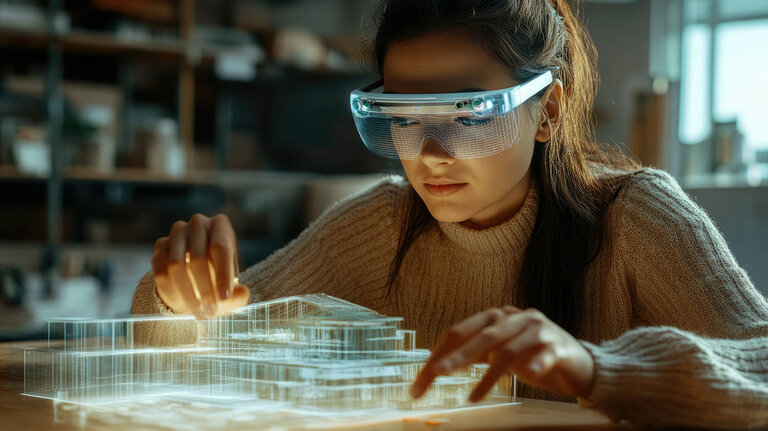
Instead of viewing isolated information on a monitor, data is projected directly into the space in which we move – for example, via AR glasses, a smartphone or an in-car display. The computer thus becomes a ‘spatial interpreter’ which, with the aid of sensors (e.g. GPS, lidar, cameras and 3D scanners) to map and analyse the surroundings and convert them into digital models. These models can then be evaluated and utilised with the aid of artificial intelligence, simulation software and cloud or edge computing – in real time and often interactively. 

The most important feature of spatial computing is therefore the linking of digital information with physical locations. These include: 

  • Augmented Reality (AR), in which digital content is superimposed onto real-world images,
  • Virtual Reality (VR), in which completely simulated spaces are created,
  • Digital twins, i.e. precise digital representations of real objects, buildings or processes,
  • autonomous systems, such as robots or drones, which can navigate and act within a space. 

All these technologies interlock to enable a new form of human–machine interaction – one that thinks and acts spatially. 

Why is spatial computing relevant for businesses? 

With spatial computing, businesses can make processes more efficient, create new customer experiences and make complex decisions more effectively. Here are some specific examples: 

1. Manufacturing industry: Digital twins for maintenance and planning

A number of well-known companies use digital twins of machines or entire production lines. Thanks to spatially accurate simulation, they can: 

  • plan maintenance before a breakdown is imminent (predictive maintenance),
  • Identify bottlenecks and optimise processes,
  • virtually test new equipment before it is built.

2. Retail: Augmented Reality in the customer experience

Retailers use spatial computing to display furniture or products virtually within customers’ own homes – via a smartphone or AR glasses. 

Benefits: 

  • Higher conversion rates,
  • Fewer returns,
  • Greater customer loyalty through immersive experiences.

3. Logistics & Transport: Real-time navigation and warehouse optimisation

Spatial computing assists with the navigation of autonomous vehicles, precise localisation within warehouses and route optimisation for supply chains. 

Relevance for government bodies and public institutions 

There is also enormous potential in the public sector: 

1. Urban planning & infrastructure: Smart cities

Local authorities use 3D city models and digital twins to simulate new construction projects, analyse traffic flows or plan disaster response measures. 

Example: The city of Hamburg is running an ‘Urban Digital Twin’ project to improve traffic management and climate resilience. 

2. Emergency services & public safety: Situational awareness

The police, fire service and civil protection agencies can use spatial computing to obtain real-time situational awareness – for example, via drones or 3D mapping of incident locations. 

Benefits: 

  • Faster response times,
  • Better coordination of operations,
  • Greater safety for staff and the public.

3. Cultural preservation & education: Digital reconstructions

Museums and heritage conservation authorities are digitising historic sites in 3D to preserve them or make them accessible – for example, through VR tours of destroyed buildings. 

Spatial computing is more than just a buzzword 

Spatial computing is the next big step in digitalisation – not just for tech giants, but also for small and medium-sized enterprises and public authorities. The ability to digitally capture real-world space and utilise it intelligently opens up new dimensions in efficiency, safety, sustainability and user experience.

Further information:

Digital Experience

Customer Service Management

Heike Abels
Referentin für Unternehmenskommunikation

Heike Abels arbeitet bei Materna als Referentin für Unternehmenskommunikation. Sie betreut redaktionell verschiedene Formate für die externe Kommunikation. Thematischer Schwerpunkt ist der Bereich Cross Market Services. Dazu zählen Enterprise Service Management, Customer Service und Cyber Security.

Related articles

Event
Frankfurt am Main
18.11.2026
BMC Helix Roadshow 2026

Meet Materna at the BMC Helix Roadshow 2026 on 18 November in Frankfurt and discover how modern service management, Agentic AI and compliance requirements work together successfully. Look forward to exclusive insights into the BMC Helix roadmap, the…

Read more
Event
Dortmund
05.11.2026
XCS Day (Xchange in Cyber Security)

At XCS Day, experts from the business and public sectors will once again come together to discuss current challenges and strategies relating to cyber security and regulation. Find out how organisations are strengthening their resilience to cyber…

Read more
Event
Dortmund
03.11.2026
FMS Information Day

On 3 November 2026, we will update you on the latest developments relating to the Federal Government’s FMS and encourage mutual exchange. The keen interest you show in every issue demonstrates that the FMS is, and will remain, a key element of…

Read more
Event
Wien
13.10.2026
Agentic AI Roundtable in Vienna

How does Agentic AI deliver real added value for IT and service organisations? At the Agentic AI Roundtable in Vienna, Materna, BMC Helix and other experts will discuss specific use cases, current challenges and next steps for businesses. Look…

Read more
Event
Berlin
13.10.2026 - 15.10.2026
Smart Country Convention (SCCON)

Come and meet us in Hall 27 at Stand 206 at the leading event for the digital state and public services. SCCON is a must-attend event for all stakeholders actively driving and shaping digital transformation. At our stand, you’ll find a use case…

Read more
Event
Amsterdam
06.10.2026 - 08.10.2026
Atlassian Team ’26 Europe

From 6 to 8 October 2026, Atlassian will be bringing the community together for ‘Team ’26 Europe’ in Amsterdam. Look forward to hands-on sessions covering AI, new products and features, live demos and certification opportunities. You’ll also have the…

Read more
Event
Berlin
01.10.2026
Open Insurance Dialog 4.0 (#OID4.0)

Open Insurance Dialog 4.0: FiDA, Identity and New Opportunities for Insurers

The insurance industry is facing a profound transformation: FiDA (Financial Data Access) and Open Insurance are creating new opportunities for data-driven services,…

Read more
Event
Online
30.09.2026
Webcast: ‘Understanding the mainframe, accelerating migration: How banks and insurers are harnessing hidden knowledge’

Mainframe and legacy systems contain decades of business logic – often inadequately documented and difficult to access. From 10.00 to 11.30, Materna and Nomain will demonstrate how AI-powered analyses can make business logic, dependencies and…

Read more
Event
Düsseldorf
30.09.2026
27th NRW ÖV Symposium

Artificial intelligence, digital sovereignty, the cloud, the data economy and cyber security form the framework for the digital transformation of public administration in North Rhine-Westphalia. This popular platform for information and dialogue on…

Read more
Event
Public Sector
Online
24.09.2026
Webcast: ‘From a jungle of registers to a digital ecosystem.’

How register modernisation, the ‘once-only’ principle and NOOTS are bringing about lasting change in public administration. Find out what challenges public authorities face, which strategies are proving effective, and how a future-proof register…

Read more