Artificial Intelligence in Public Administration

Artificial intelligence (AI) is becoming increasingly important for public administration. It helps public authorities to automate processes, analyse information efficiently and improve digital services for citizens. AI is therefore becoming a key component in the modernisation and future-proofing of the public sector.

Hype, risk or game-changer?

Artificial intelligence (AI) is one of the most significant technological developments of our time. Whilst businesses are already putting numerous AI applications into productive use, the public administration in many countries is still in a phase of trialling and transformation. In Germany, AI is viewed both as an opportunity to modernise public services and as a challenge for data protection, transparency and organisational change.

The debate oscillates between high expectations, critical voices and the danger of excessive hype. In fact, the success of AI in public administration depends less on the technology itself than on its responsible implementation, the legal framework and its acceptance by staff and members of the public.

How AI is being adopted in public administration

Public administration faces a wide range of challenges: rising caseloads, complex regulatory requirements, limited resources, a shortage of skilled workers and growing expectations regarding digital services. AI is increasingly being seen as a tool for tackling these challenges.

Whilst early projects focused on the automation of standardised processes, the development of generative AI in particular has significantly expanded the range of possible applications. Modern language models can generate text, summarise information, analyse documents and support administrative staff with knowledge-intensive tasks.

The most important areas of application include:

  • Automated processing of applications
  • Digital assistants and chatbots for public enquiries
  • Document and file analysis
  • Automatic classification of cases
  • Drafting of texts for decisions and letters
  • Summarising extensive case files
  • Research and knowledge management
  • Deadline and process management
  • Support for IT and software projects
  • Forecasting and planning models for public sector tasks

The federal government, the Länder and local authorities are already trialling numerous pilot projects. However, widespread implementation is still at an early stage of development in many places.

Benefits of AI for Germany’s public administration

  • Increased efficiency

AI can automate routine tasks and significantly reduce processing times. This relieves staff of time-consuming standard processes, allowing them to focus more on complex issues.

  • Accelerating digitalisation

Much administrative data is still held in paper files, PDF documents or various IT systems. AI can access such information and integrate it into digital processes. This accelerates the digitalisation of public administration as a whole.

  • Alleviating the impact of skills shortages and demographic change

The public sector is facing a significant decline in staff numbers due to age-related retirements. AI can help maintain the efficiency of the administration despite limited staff resources.

  • Improved public services

Digital assistants enable faster communication with citizens, in some cases available round the clock. Enquiries can be answered more quickly and information provided in a more targeted manner.

  • Higher data quality

AI systems can analyse large volumes of data, identify inconsistencies and structure data sets. This improves the quality of administrative data and supports well-informed decision-making.

  • Faster decision-making processes

Through intelligent preliminary analyses and automated suggestions, administrative procedures can be accelerated and decision-making processes made more efficient.

  • Strengthening trust in public services

A modern, efficient and service-oriented administration can help to strengthen public confidence in government institutions.

What is needed to introduce AI into public administration?

The introduction of AI requires far more than simply procuring new software. Successful AI projects depend on technical, organisational and legal prerequisites.

  • Digital infrastructure

High-performance IT systems, secure networks, modern data centres and cloud technologies form the basis for the productive use of AI.

  • Data quality and data availability

AI requires high-quality, structured data. However, many public authorities still operate using separate information systems. Improving data quality and integrating existing systems are therefore key prerequisites.

  • Eliminating data silos

Administrative data is often held within different specialist processes and organisational units. To realise the full potential of AI, data must become interoperable and usable across different public authorities.

  • Legal certainty

Data protection, information security and transparency must be guaranteed at all times. The General Data Protection Regulation (GDPR) and the European AI Act establish important legal frameworks for this.

  • Skills and further training

Staff require new skills in working with AI systems. Training and professional development programmes are therefore becoming a key component of administrative modernisation.

  • Trust and acceptance

The successful introduction of AI depends largely on whether staff and members of the public accept and trust the technology.

Roadmap for the introduction of AI in public administration

The successful introduction of artificial intelligence rarely takes the form of a single IT project. Rather, it is a strategic transformation process that brings together technology, organisation, legal matters and staff development.

To begin with, public authorities should assess their existing processes, data sets and technical systems. Not every administrative process is equally suited to the use of AI. Repetitive, data-intensive or document-based tasks offer particularly great potential.

Key questions include:

  • Which processes involve a high administrative workload?
  • Where are there data disconnects or routine manual tasks?
  • What data is already available in digital form?
  • What legal requirements need to be taken into account?

Following the analysis, specific use cases should be identified and evaluated. It is advisable to prioritise these according to benefit, feasibility and risk.

Typical starter projects include:

  • Citizen chatbots
  • Document analysis
  • Automatic process classification
  • Knowledge management
  • Support with drafting official notices and letters

Pilot projects of a manageable scale provide initial experience and build acceptance within the organisation.

AI systems require high-quality data and a robust technical infrastructure. Public authorities should therefore assess at an early stage whether existing specialist procedures, databases and document management systems are suitable for AI applications.

Key tasks include:

  • Improving data quality
  • Digitising analogue documents
  • Integrating existing systems
  • Establishing secure cloud or data centre structures
  • Ensuring data protection and information security

Clear lines of responsibility must be established before the system is put into production. AI governance creates transparency and ensures that legal and organisational requirements are met.

These include, amongst other things:

  • Definition of responsibilities
  • Documentation of risks
  • Quality controls
  • Regulations on human oversight
  • Compliance with the GDPR and the AI Act

Employee acceptance is a key factor for success. AI should not be seen as a replacement for staff, but as a tool to support their work.

Training and professional development programmes help to build skills in working with AI and to allay any reservations.

Planning is followed by practical testing. Pilot projects should be carried out with clearly defined objectives, key performance indicators and success criteria.

Possible metrics include:

  • Processing times
  • Error rates
  • User satisfaction
  • Resource savings
  • Service quality

The results form the basis for further decisions.

Successful pilot projects should be rolled out gradually to other departments. At the same time, AI systems must be regularly monitored, updated and adapted to new legal or organisational requirements.

In the long term, this will result in a learning administration that does not view AI as an isolated project, but as an integral part of its digitalisation strategy.

Experience from national and international projects shows that successful AI implementations depend primarily on five factors:

  • Clear strategic objectives
  • High data quality
  • Legal certainty
  • Early involvement of staff
  • Continuous performance measurement and optimisation

Taking these requirements into account lays the groundwork for AI to make a lasting contribution to the modernisation of public administration.

A question of organisation: How AI is being adopted in the public sector

The introduction of AI is, first and foremost, a process of organisational change. Technical solutions alone are not enough if existing structures and working practices remain unchanged.

Successful projects are characterised by the following factors:

  • Support from senior management
  • Clear strategic objectives
  • Interdisciplinary collaboration
  • Early involvement of staff
  • Transparent communication
  • Ongoing evaluation of results

AI Governance

So-called AI governance plays a central role. It encompasses the organisational rules governing the development, procurement, deployment and monitoring of AI systems.

Key questions include:

  • Who is authorised to use AI?
  • Who reviews the results?
  • Who bears responsibility for decisions?
  • How are risks documented and assessed?
  • How is compliance with legal requirements ensured?

Pilot projects and scaling

Many public authorities begin with pilot projects in clearly defined areas. This enables them to gain initial experience, assess the practical benefits and test organisational and legal requirements.

In the long term, however, it is the ability to scale up that determines whether AI can generate sustainable benefits for the public sector. Successful pilot projects must be integrated into existing processes and rolled out to other departments. Only then can efficiency gains and quality improvements take effect on a lasting basis.

Legal framework: The EU AI Act

The European AI Act establishes, for the first time, a comprehensive legal framework for artificial intelligence within the European Union.

The AI Act takes a risk-based approach. Particularly sensitive applications may be classified as high-risk AI. This may also apply to certain administrative procedures.

Special requirements apply to such systems:

  • Risk management
  • Transparency requirements
  • Traceability
  • Data quality
  • Documentation
  • Cyber security
  • Human oversight

The AI Act will form an important basis for the procurement, development and use of AI solutions in public administration in future.

Risks and challenges

Despite its considerable potential, the use of AI is associated with various risks.

  • Data Protection

Public authorities process large volumes of sensitive personal data. Protecting this information is a top priority.

  • Bias and Discrimination

AI systems learn from existing data. If this data contains biases or societal prejudices, these may be unintentionally reproduced.

  • Hallucinations

Generative AI, in particular, can generate information that sounds plausible but is factually incorrect. Therefore, AI-generated results must not be accepted without verification.

  • Transparency and traceability

Administrative decisions must be comprehensible and verifiable. However, many modern AI systems are considered difficult to explain.

  • Explainable AI

For this reason, the development of explainable AI systems is becoming increasingly important. The aim is to make decision-making processes transparent and to strengthen trust in AI applications.

  • Technological dependencies

Many AI solutions originate from international technology companies. This raises questions about digital sovereignty and long-term control over critical technologies.

  • Cybersecurity

As digitalisation advances, so too do the requirements for protection against cyber-attacks and manipulation.


Smart Government and Smart Cities

The use of AI is a key component of the ‘Smart Government’ concept. This refers to the intelligent use of digital technologies to improve public services and administrative processes.

The aim is to create a public administration that operates efficiently, is data-driven, transparent and citizen-centred.

Smart cities use digital technologies, sensor systems and data analytics to make urban infrastructure more sustainable and efficient.

Possible areas of application include:

  • Intelligent traffic management
  • Energy and resource management
  • Environmental and air quality monitoring
  • Digital citizen services
  • Public safety
  • Smart waste management
  • Infrastructure management

A new trend in development is what is known as ‘predictive government’. This involves using data analysis and AI to predict future developments and prepare political or administrative measures at an early stage.

Examples of applications include:

  • School and nursery planning
  • Traffic forecasts
  • Energy demand analyses
  • Disaster management
  • Healthcare
  • Predictive maintenance of public infrastructure

Modern smart government concepts no longer focus solely on efficiency, but on the needs of citizens. Services should be delivered in a simpler, more personalised and, where possible, proactive manner.

Future prospects

Experts anticipate that AI will increasingly become a standard tool in public administration in the coming years. Generative AI, in particular, opens up new possibilities for knowledge work, communication and process automation.

At the same time, issues of transparency, ethics, data security and digital sovereignty will continue to grow in importance. Long-term success depends on whether we can successfully combine technological innovation with fundamental democratic values and the principles of the rule of law.

Conclusion

Artificial intelligence has the potential to fundamentally transform public administration. It can speed up processes, help alleviate skills shortages, drive digitalisation forward and improve the quality of service for citizens.

At the same time, its deployment requires a modern digital infrastructure, high-quality data, skilled staff, clear governance structures and a reliable legal framework. Data protection, transparency and human oversight remain key prerequisites.

Whether AI in public administration is ultimately hype, a risk or a game-changer depends less on the technology itself than on how responsibly it is designed. Used correctly, it can make a significant contribution to the modernisation of the state, public administration and local government structures, and pave the way for an intelligent, citizen-centred ‘smart government’.


Artificial intelligence for public administration – harnessing the potential successfully

AI can speed up administrative processes, reduce the workload on staff and improve services for the public. We support you every step of the way, from strategy development and pilot projects right through to the scalable roll-out of intelligent solutions within your organisation.

Get advice now

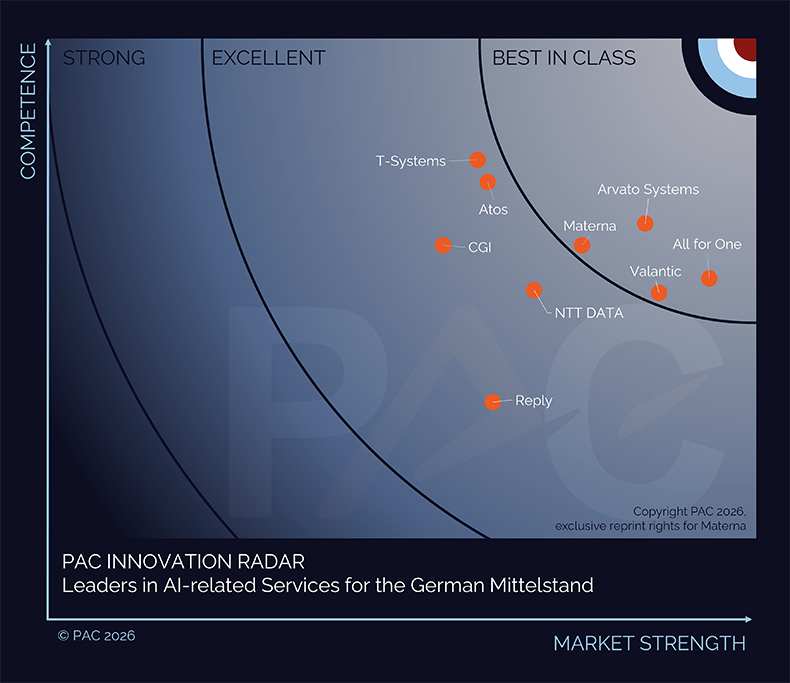
Best in Class – Materna in ‘Leaders in AI-related Services 2026’

The analyst firm PAC has assessed the most compelling approaches to meeting the growing demand for AI and positioned the leading providers in a PAC INNOVATION RADAR series on ‘AI-related IT Services in Europe, France, Germany and the UK 2026’. A total of 31 IT service providers relevant to the sector were analysed. Materna has achieved an outstanding result, being named “Best in Class”. Its Sovereign AI approach and expertise in the public sector were particularly impressive.

References & Use Cases

AI initiative for the federal government

ITZBund is working with Materna to trial the use of AI to support software development. The project is based on KIPITZ, ITZBund’s AI portal, combined with high-performance software from NVIDIA AI Enterprise. The aim of the pilot project is to boost efficiency, secure a skilled workforce and accelerate the government’s digitalisation projects.

Air-gapped cloud solution for the federal administration

ITZBund has commissioned IONOS to set up a private enterprise cloud, which will be operated in ITZBund’s data centres. Materna is providing support as a cloud consultancy partner. We are delighted to be supporting this pioneering project over the next five years. Our experts provide advice on application scaling and operation, as well as on migration and integration issues relating to the existing infrastructure. Materna will also be providing advice on the implementation of new cloud services within the business domain. Furthermore, we at Materna are well-prepared to develop and operate future specialist procedures as ‘cloud-native’ from the outset.

Forest Planning 4.0

The Forest Planning 4.0 project is creating a digital twin of the Bavarian Forest. It is being used to carry out a survey of the state-owned forest and to gather detailed information on the composition, location and condition of the vegetation. Precise and up-to-date data generated using AI helps to ensure the health and sustainable management of the forest. On behalf of Bayerische Staatsforsten AöR, Materna, in collaboration with a European consortium of forestry partners, is digitising almost the entire Bavarian state-owned forest, comprising around 800,000 hectares of woodland.

ATLAS IT specialist procedure

Since 1992, Materna has been working continuously on the further development of the specialist IT system ATLAS (Automated Tariff and Local Customs Clearance System) for the German customs administration. ATLAS was developed by Materna on behalf of the Federal Ministry of Finance in collaboration with what is now ITZBund. As part of the software development process, Materna draws up functional and technical concepts, implements software components and provides support for the integration of the overall system. ATLAS is used to process declarations for the movement of goods and their subsequent placement under a customs procedure, as well as administrative documents, electronically.

Intelligent traffic management

The federal government’s Autobahn GmbH has equipped its traffic control centres with a modern, modular operating system, thereby laying the groundwork for the integration of future developments in automated driving. This enables road users to reach their destinations even more safely and reliably. Materna and TraffGo Road are supporting this pioneering project by providing key development services and contributing to various projects.

Development of the mobility data platform

Materna is responsible for the development, set-up and operation of the mobility data platform for NRW.Mobidrom GmbH. The Mobidrom data platform processes and aggregates mobility data across all modes of transport and makes it available on a non-discriminatory basis. The data and the services offered via the platform are aimed at local authorities, private and public transport operators, as well as research institutions and start-ups.

Chatbots for the Federal Administration

As part of the consolidation of services within the federal administration, an AI-supported base component is now being implemented. These so-called ‘Federal Bots’ complement the existing communication channels through which information and services provided by the Federal Administration are made available and enquiries can be answered automatically. Materna implements the individual bots for each organisation that utilises this core component, in accordance with their specific requirements.

Data room for smart living

Through the digitalisation and networking of living spaces (Smart Living), many new applications and digital services can be developed that make living more energy-efficient, safer and more comfortable. Together with other partners, Materna is developing a secure data space for energy-efficient and sustainable living as part of the SmartLivingNEXT project. This platform provides easy access to smart living data. Thanks to the platform’s open architecture, various data sources can be integrated and shared, creating a diverse data ecosystem.

FAQ

Costs vary considerably depending on the specific use case, technical infrastructure and the complexity of integration. Whilst smaller pilot projects can be implemented even with a limited budget, large-scale AI solutions require investment in IT systems, data management, training and day-to-day operations.

In particular, cloud-based AI applications such as chatbots, text assistance systems and document analysis tools can often be used without the need for far-reaching changes to existing business processes. However, this requires a secure IT connection and a clear data protection assessment.

Responsibility usually lies with a combination of senior management, the IT department and the business units. CIOs, digitalisation officers or dedicated AI or innovation teams often take on the role of coordination and management.

Success can be assessed on the basis of specific key performance indicators, such as shorter processing times, lower error rates, reduced workload for staff, greater public satisfaction or faster process throughput.

The solutions used range from commercial offerings from major technology providers to specialised GovTech applications and, increasingly, open-source-based systems. The choice depends heavily on data protection requirements, IT strategy and sovereignty objectives.

By using open standards, modular architectures and, where appropriate, open-source solutions, public authorities can strengthen their digital sovereignty. It is also advisable to adopt a multi-provider strategy rather than being tied to individual providers.

Integration is usually achieved via interfaces (APIs), middleware or supplementary AI modules. The aim is not to replace existing systems entirely, but to expand them gradually and provide intelligent support.

In principle, responsibility for administrative decisions remains with the authority or the relevant staff members. AI systems serve as a support, but do not replace decision-makers who bear legal responsibility.

Our expert

Portrait vom Ansprechpartner Thomas Feld

Thomas Feld
Vice-President of Data Economics and AI

What’s on our minds at the moment

Event
Verwaltung Digital
Public Sector
Berlin
23.11.2026 - 24.11.2026
Digital Justice Summit

Join us at the Digital Justice Summit and attend our presentation, “From Cash Book to Digital Assistant: How the Hessian Judicial System Is Rethinking Financial Audits,” which we are delivering jointly with the Hessian Judicial System on the second…

Read more
Event
Verwaltung Digital
Public Sector
Online
29.10.2026
Webcast: “Digital sovereignty as the foundation for a future-ready public administration”

How can specialized systems, platforms, and processes be designed to meet the requirements of the public sector while also being operated securely, efficiently, and independently? How do innovative technologies such as Agentic AI help make…

Read more
Blog
Verwaltung Digital
Public Sector
23.06.2026
BDI’s ‘EinfachStaat’ agenda: How public administration is going digital

Registering a car online, entering company details just once, using administrative services without having to switch between different platforms: the BDI’s ‘EinfachStaat’ agenda sets out where the digital state stands today and which reforms are…

Read more
Press
Corporate
Data & AI
Public Sector
Dortmund
17.06.2026
SPARK, the AI for public authorities: Materna group helps public authorities speed up approval processes

With the launch of SPARK Workflow, public authorities now have access to a centralised AI-powered tool to process planning and approval procedures more quickly. As a member of the consortium responsible for the project, the Materna Group is…

Read more
Short News
Public Sector
30.04.2026
Materna & TrustNXT: Strategic technology partnership for digital trust protection

Digital content is now a key component of critical processes – which makes its authenticity all the more important.

That is why Materna and TrustNXT…

Read more
Blog
Resilience
Public Sector
23.01.2026
Focus on IT resilience: What the Berlin power cut means for organisations

On 3 January 2026, one of the most severe power cuts in decades occurred in Berlin’s Lichterfelde district. An attack on a cable bridge left around…

Read more
Short News
Digital Experience
Data & AI
Public Sector
11.12.2025
Chatbot technology

In the public sector, chatbots facilitate communication between members of the public and the authorities. The Cybercrime Co-ordination and Contact…

Read more
Blog
Verwaltung Digital
Sustainability
Public Sector
25.11.2025
Sustainability through IT: How digital services strengthen the state, society and the environment

In the sustainability sector, there is often talk of the ‘twin transformation’ – digitalisation and sustainability as a shared challenge. But how…

Read more
Blog
Verwaltung Digital
Data & AI
Public Sector
04.11.2025
Intelligent automation: How AI is making public authorities fit for the future

How can public authorities work more quickly, in a more user-centred way and in full compliance with the law, despite a shortage of skilled staff,…

Read more