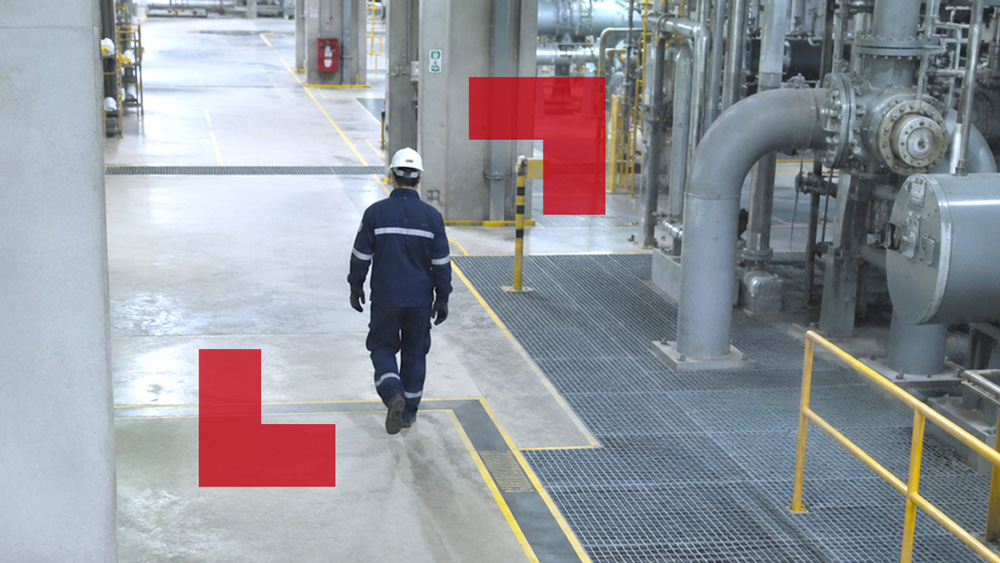
Intelligently monitor safety zones before breaches turn into incidents

Our AI-powered video analytics solution for critical infrastructure, SecuSite AI, detects people entering defined security zones, the absence of protective equipment and non-compliant behaviour in real time. This enables risks to be identified earlier and measures to be taken more quickly.

Contact Us

Safety zones are only effective if breaches are immediately apparent

Critical infrastructure involves highly sensitive facilities, clearly defined operational procedures and areas with a heightened risk potential. Strict access, conduct and security regulations therefore apply in substations, ports, airports, industrial sites and utility facilities. Security zones are not merely a matter of maintaining order; they protect people, equipment and the continuity of critical services.

However, particularly in KRITIS environments, it is not enough simply to have rules in place. What is crucial is whether breaches are detected in good time, correctly assessed and properly documented. With the KRITIS Framework Act, physical resilience, protective measures and robust risk and response structures have come even more sharply into focus.

What happens if a breach of the rules in a security zone is noticed too late?

A person enters a security-critical area subject to clear access rules. The incident is captured by the cameras but goes unnoticed at first. Traditional video surveillance records such events but often only detects breaches of defined security rules retrospectively, or only when the video footage is being actively monitored.

SecuSite AI analyses video data in real time and detects when predefined rules for security zones are breached. Rule breaches are automatically recorded and forwarded, based on predefined rules, to the relevant systems or responsible personnel. This enables security-related incidents to be assessed more quickly and appropriate measures to be initiated at an early stage.

AI-powered video analysis for intelligent monitoring of security zones

Our AI-powered video analytics solution, SecuSite AI, monitors defined security zones in real time and automatically detects critical anomalies. These include, for example, unauthorised entry into sensitive areas, unusually long stays, atypical movement patterns, repeated approaches or other anomalies that deviate from expected normal operations. This transforms passive video surveillance into an active system that provides targeted support to security managers in assessing situations and initiating appropriate measures. Zone-based event detection, intelligent alerting and integration into existing security processes are integral parts of the solution.

Get in touch

The combination of edge AI, rule-based sensor technology and modern vision-reasoning models (e.g. NVIDIA Cosmos) transforms video data into an intelligent analysis process: efficient at the local level, in-depth at the central level – enabling valid, context-based decisions.

  1. Sensors & Triggers (Edge) – Rule-based activation on-site
    – Combination of cameras, motion detectors, access control, etc
    .– Defined rules trigger analysis and/or recording –
    Focus solely on relevant situations
  2. Event Filtering & Clip Creation – Intelligent pre-processing
    – Selection of relevant events (no flood of raw data)
    – Creation of short, focused video clips
    – Initial structured description (metadata / tags)
  3. Centralised AI Analysis (Cosmos Reason / Cosmos 3) – Scene understanding & context analysis
    – Processing in the cloud or on secure customer infrastructure
    – Vision reasoning models analyse:
    – Relationships and interactions
    – Sequences of events
    – Anomalies and patterns
  4. Context & recommended action – Interpreted events rather than raw data
    – Automatic classification of the situation (e.g. security-relevant, critical)
    – Reduction of false alarms
    – Handover to control centre, systems or processes

Detecting a breach is not the end of the process. SecuSite AI helps to process incidents in security zones in a structured manner and integrate them into existing security processes. Incidents such as unauthorised entry, unauthorised presence or breaches of security regulations can be automatically prioritised, documented and forwarded to the relevant departments or downstream processes. Associated image and video information helps to assess situations more quickly, derive appropriate measures in a transparent manner and make decisions based on reliable information. The platform is designed to feed events into existing control centre, ticketing and reporting chains, rather than simply displaying security-related alerts on a monitor.

In addition to immediate detection, SecuSite AI can also serve as a basis for further analysis. This enables security-related events, patterns and processes to be evaluated in a more targeted manner, for example to identify anomalies, vulnerabilities or areas for optimisation. Documented security-related incidents can serve as a basis for better understanding interrelationships and gaining insights for the further development of security measures. Storage and further processing always take place in accordance with the applicable data protection regulations. Which analyses are appropriate and feasible in a specific context should be assessed on a case-by-case basis and worked out in detail jointly.

Your benefits

Increased reaction speed


Breaches of defined safety rules are detected immediately. Safety officers can intervene before a deviation leads to an accident, a plant shutdown or a safety incident.


Reducing the workload of security staff


Instead of constantly monitoring screens, staff receive targeted support when relevant incidents occur. This reduces the workload in control centres and allows staff to focus more on genuine incidents.


Comprehensive documentation


Breaches of the rules are documented, including the time, location, zone allocation and type of incident. This supports internal analyses, compliance with documentation requirements and audit-proof processing.


In-depth analysis and evaluation


Recurring patterns become apparent. Operators can identify the areas where regulatory breaches occur most frequently, where processes need to be fine-tuned, and which protective measures are effective.


The implementation

1. Planning

Comprehensive advice on defining relevant areas and analysis objectives. Risk assessment: What events might occur and which processes should be prepared for? Development of escalation plans for anomalies, breaches and critical incidents.

2. Installation

We integrate the data streams with our platform in compliance with data protection regulations. The solution can be operated as a cloud service on EU servers or on-premises within your own infrastructure.

3. Development

This is followed by training the artificial intelligence to improve its ability to detect anomalies and reduce false alarms. In addition, rules, escalation levels and triggering workflows are refined.

4. Operation

The application is put into live operation. Events are documented, video data is analysed, relevant anomalies are prioritised and reported, and the data is made available for further analysis.

That’s why Materna

In KRITIS environments, it is not enough simply to detect anomalies. What is crucial is that a detected incident is turned into a robust process: with clear classification, rapid escalation, technical interoperability and traceable documentation. This is precisely where Materna’s strength lies. We combine AI-powered video analytics with integration expertise, regulatory knowledge and experience in complex security and IT environments.

Understanding KRITIS

We combine technological expertise with a clear understanding of the regulatory and operational requirements of critical infrastructure.

Integration rather than a stand-alone solution

Our platform integrates with existing security, control centre and IT systems, rather than creating new silos.

Self-sufficient operating models

Depending on the protection requirements, the solution can be deployed on-premises, at the edge, in a hybrid environment or within defined cloud models.

From detection to response

We consistently view video analysis as part of an end-to-end security and escalation process.

Audit readiness right from the start

Documentation, traceability and interoperable reporting processes are taken into account right from the start.

End-to-end support

We support you every step of the way, from defining the use case right through to safe, large-scale operation.

Let’s go into more detail

SecuSite AI monitors defined security zones in real time and automatically detects when rules are breached. These include, for example, unauthorised entry into sensitive areas, unauthorised loitering, breaches of security protocols or suspicious movement patterns. This means that security-related incidents are identified earlier and can be dealt with more quickly.

Traditional video surveillance records incidents but is generally unable to recognise their significance automatically. In security-critical environments, staff have to monitor numerous video feeds simultaneously and assess breaches manually. This is prone to error, time-consuming and virtually impossible to carry out comprehensively whilst operations are ongoing.

Among other things, the solution can detect unauthorised entry into defined areas, people remaining in areas outside authorised times, unusually long stays in sensitive zones, a lack of personal protective equipment, and other deviations from the intended operational procedures. The rules being monitored can be tailored to the specific site and use case.

SecuSite AI is designed to integrate detected events into existing control centre, ticketing and reporting processes. Relevant incidents can be prioritised, documented and forwarded to the relevant departments. This means that the solution does not stop at detection, but also supports operational follow-up.

This is particularly relevant for operators of critical infrastructure and other organisations with sensitive areas, clear access rules and heightened security requirements. These include, for example, energy suppliers, network operators, ports, airports, industrial companies, water utilities and operators of security-critical premises.

Yes. Safety zones, access rules, duration of stay, time slots and other guidelines can be adapted to local conditions and operational requirements. This results not in a rigid, one-size-fits-all solution, but in an approach that is tailored to real-world processes and risk areas.

Automated monitoring reduces the workload on security staff, minimises blind spots in surveillance and speeds up the response to relevant incidents. Furthermore, it improves the traceability of incidents and provides a robust basis for documentation, analysis and the further development of security measures.

Please feel free to contact us

Portrait von Ansprechpartner Marcus Goetting

Marcus Götting
Leiter Competence Center IoT