21.01.2025
Blog
Think ahead

Technology Business Management – Making IT costs and value contribution transparent

The value contribution of IT is essential to business success, yet it is often overlooked due to an excessive focus on costs. Too rarely is attention paid to managing and improving the value contribution of IT – and too few models and best practices address this issue. Technology Business Management (TBM) provides a framework for making IT costs and value creation transparent and for making informed decisions on optimisation. 

Nadin Ebel
IT-Projektleiterin

Shedding light on the matter: the costs and benefits of IT services 

Technology Business Management (TBM) enables the value contribution of IT to be managed and optimised. This is achieved by using TBM to create transparency regarding IT costs on the one hand and the value created by IT services on the other. It is a framework specifically designed for the management and optimisation of IT resources and costs.  

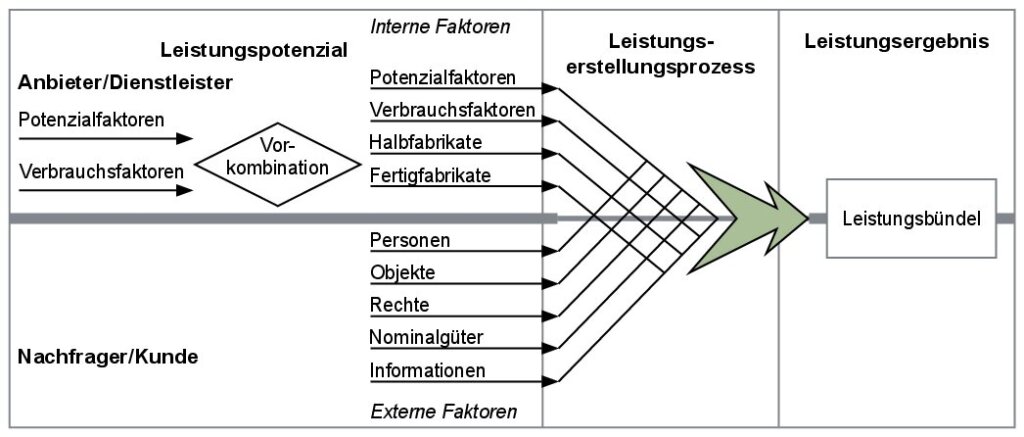
With regard to costs, the focus is on the so-called ‘production factors’ involved in delivering IT services, such as hardware, software and human resources, for example customer service or process components.  

Integrative service provision: Fließ 2009, p. 21 -- Fließ, Sabine (2009): Service Management: Shaping and Managing Customer Integration, Wiesbaden 2009.

At TBM, interlinked service components form the value chain of the respective IT service. This creates a cascade of service components and ‘value-adding steps’. This value-adding process can be understood as the enhancement of products or service components through processing or further refinement (e.g. virtualisation service → OS service → database service).  

TBM lays the foundation for IT-specific cost and performance accounting, focusing on the costs of IT services and determining the benefits for users/customers or the contribution to the business result.  

The ability provided by TBM to compare IT costs against the benefits to the business result or business processes facilitates a value-oriented approach. With the help of this information, it is possible to make informed decisions regarding the service portfolio and to initiate and manage measures aimed at creating value from IT services. This enables organisations to initiate targeted investments in technology or personnel for specific service components, to make the value added by the investment (its benefits) transparent, and to assess, in line with governance principles, whether budgets are being allocated in accordance with corporate objectives.  

Taxonomy for structuring IT service components 

TBM is based on a standardised taxonomy. It is backed by the non-profit organisation TBM Council, which was founded in 2012. The organisation is dedicated to developing a defined framework for the business management of IT. The TBM Council sees itself as a body chaired by managing directors from leading, innovative companies. It provides a range of ‘tools’ in the form of the aforementioned taxonomy and metrics, as well as the TBM Framework and TBM Model. In addition, it offers, amongst other things, further best practices and training and certification programmes relating to TBM.  

TBM Taxonomy as a ‘tool’ for determining IT costs on a cost-allocation basis

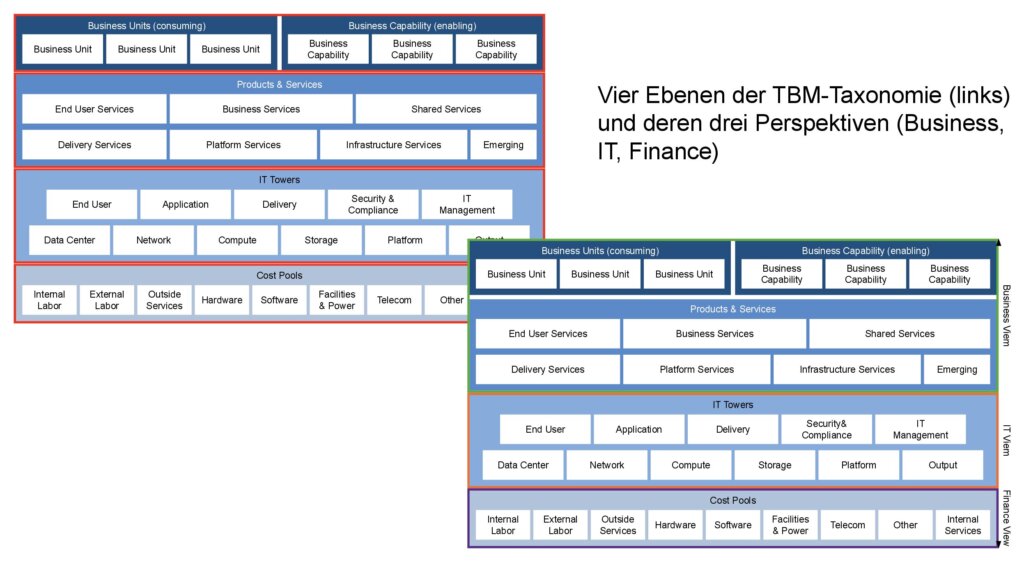
At the heart of TBM lies a hierarchical taxonomy. This is used to structure IT objects as a value chain, thereby permeating the entire IT organisation and its services. In the context of  

  • Cost Pools: cost categories within the IT sector, e.g. staff costs, material costs, capital expenditure (depreciation)
  • Towers: cost centres within the IT sector, in particular IT organisational units focused on technologies or management tasks
  • IT services: cost centres within the IT sector. IT services are composed of the outputs of the towers or other IT services.  

This enables the components, connections and interdependencies of IT service components to be mapped out, thereby providing a basis for decision-making regarding the planning, management and improvement of IT with a view to business objectives and customer success. The TBM taxonomy enables IT costs to be presented transparently; for example, in the context of the technology or platform portfolio, it shows total costs and unit costs for technologies, as well as the hardware costs of sites or platforms. Information on utilisation or consumption rates is also possible, amongst other things.  

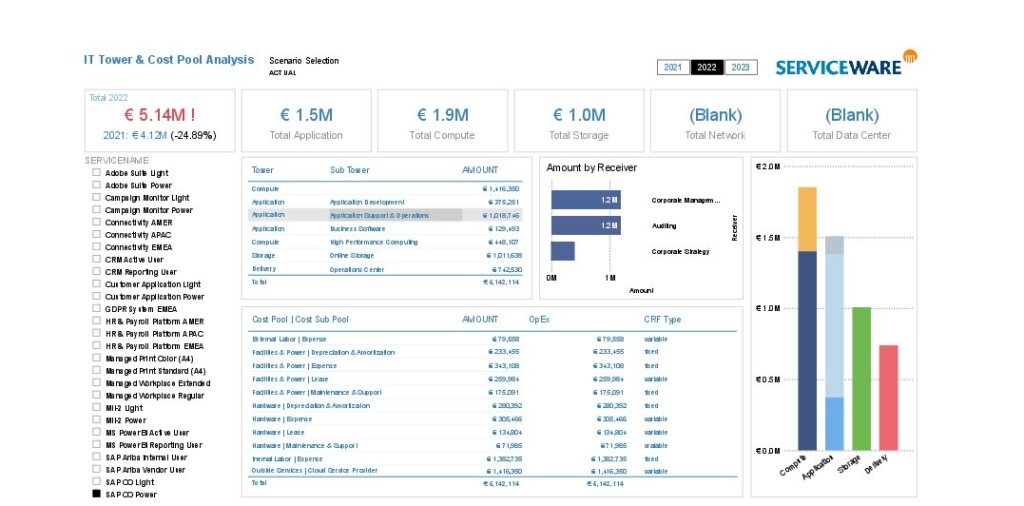
Sample analyses based on the TBM taxonomy

Both the IT department and the business units can recognise cost drivers and thus identify opportunities for optimisation. It can be useful for a business unit to understand the reasons behind the IT costs allocated to it. The statement that a company has spent 5 million euros on software says nothing about the business benefits of this expenditure – or the value this investment has generated for the company. TBM enables costs and value creation to be broken down and allocated, thereby establishing a cost-benefit ratio. 

TBM is not the only approach for enabling transparency and insights into IT costs and performance, and for improving the view of value creation. General aspects of IT cost controlling and cost and performance accounting also offer possibilities. In any case, TBM, as a framework, must be adapted to the specific needs of the organisation in question, and the objectives of IT financial management must be reflected in line with governance principles. This is where the main effort lies and where the key success factor for establishing effective IT controlling and the organisation’s value-generating value streams can be found.  

About the authors 

Nadin Ebel works as an IT project manager, ITSM consultant and accredited ITIL trainer. She has many years’ experience in ITIL, process and service management, IT infrastructure and project management. She has also made a name for herself as an author of specialist books. 

Sylvia Hochrieser works as an ITSM consultant and IT programme/project manager. Among other things, she is a certified consultant in the field of IT financial management. She has many years’ experience in ITIL, process and service management, and programme/project management. 

Nadin Ebel
IT-Projektleiterin

Nadin Ebel arbeitet als IT-Projektleiterin, Beraterin für ITSM und akkreditierte ITIL-Trainerin. Sie verfügt über langjährige Erfahrungen in ITIL, Prozess- und Service-Management, IT-Infrastruktur und Projektmanagement. Sie hat sich zudem als Fachbuch-Autorin einen Namen gemacht.

Related articles

Event
Frankfurt am Main
18.11.2026
BMC Helix Roadshow 2026

Meet Materna at the BMC Helix Roadshow 2026 on 18 November in Frankfurt and discover how modern service management, Agentic AI and compliance requirements work together successfully. Look forward to exclusive insights into the BMC Helix roadmap, the…

Read more
Event
Dortmund
05.11.2026
XCS Day (Xchange in Cyber Security)

At XCS Day, experts from the business and public sectors will once again come together to discuss current challenges and strategies relating to cyber security and regulation. Find out how organisations are strengthening their resilience to cyber…

Read more
Event
Dortmund
03.11.2026
FMS Information Day

On 3 November 2026, we will update you on the latest developments relating to the Federal Government’s FMS and encourage mutual exchange. The keen interest you show in every issue demonstrates that the FMS is, and will remain, a key element of…

Read more
Event
Wien
13.10.2026
Agentic AI Roundtable in Vienna

How does Agentic AI deliver real added value for IT and service organisations? At the Agentic AI Roundtable in Vienna, Materna, BMC Helix and other experts will discuss specific use cases, current challenges and next steps for businesses. Look…

Read more
Event
Berlin
13.10.2026 - 15.10.2026
Smart Country Convention (SCCON)

Come and meet us in Hall 27 at Stand 206 at the leading event for the digital state and public services. SCCON is a must-attend event for all stakeholders actively driving and shaping digital transformation. At our stand, you’ll find a use case…

Read more
Event
Amsterdam
06.10.2026 - 08.10.2026
Atlassian Team ’26 Europe

From 6 to 8 October 2026, Atlassian will be bringing the community together for ‘Team ’26 Europe’ in Amsterdam. Look forward to hands-on sessions covering AI, new products and features, live demos and certification opportunities. You’ll also have the…

Read more
Event
Berlin
01.10.2026
Open Insurance Dialog 4.0 (#OID4.0)

Open Insurance Dialog 4.0: FiDA, Identity and New Opportunities for Insurers

The insurance industry is facing a profound transformation: FiDA (Financial Data Access) and Open Insurance are creating new opportunities for data-driven services,…

Read more
Event
Online
30.09.2026
Webcast: ‘Understanding the mainframe, accelerating migration: How banks and insurers are harnessing hidden knowledge’

Mainframe and legacy systems contain decades of business logic – often inadequately documented and difficult to access. From 10.00 to 11.30, Materna and Nomain will demonstrate how AI-powered analyses can make business logic, dependencies and…

Read more
Event
Düsseldorf
30.09.2026
27th NRW ÖV Symposium

Artificial intelligence, digital sovereignty, the cloud, the data economy and cyber security form the framework for the digital transformation of public administration in North Rhine-Westphalia. This popular platform for information and dialogue on…

Read more
Event
Public Sector
Online
24.09.2026
Webcast: ‘From a jungle of registers to a digital ecosystem.’

How register modernisation, the ‘once-only’ principle and NOOTS are bringing about lasting change in public administration. Find out what challenges public authorities face, which strategies are proving effective, and how a future-proof register…

Read more