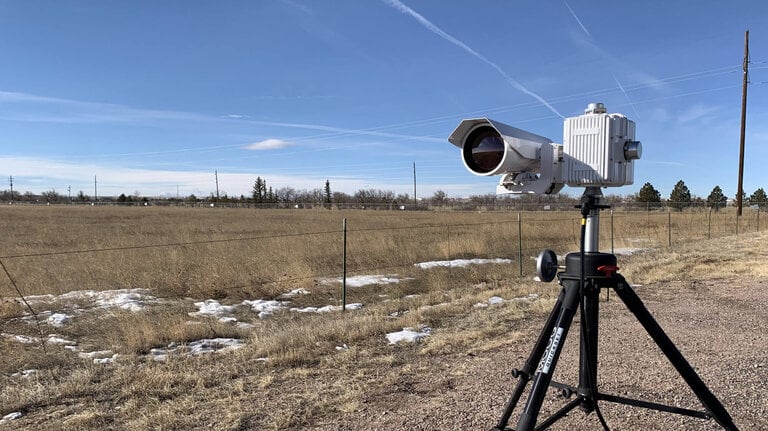
In Cochstedt, Saxony-Anhalt, the Federal Ministry of the Interior, the Federal Ministry of Research, Technology and Space, and the German Aerospace Centre have opened the new Drone Safety Technology Centre. The centre will conduct research into technologies for the safe operation of drones, as well as for the detection and defence against unauthorised drones, and will integrate and test these technologies under realistic conditions.
The centre is launching against a backdrop of heightened security concerns. Time and again, drones have caused disruptions at airports, Bundeswehr sites or critical infrastructure facilities. Often, these are operated by hobbyists. However, the discovery of explosives on a drone at Leipzig/Halle Airport has shown that the threat is very real.
The facility in Cochstedt also illustrates the direction in which drone security is developing: towards a systemic task. The DLR emphasises the development, maturation, integration and operationalisation of various technologies and procedures, which must be interconnected. For operators of critical infrastructure, this holds an important insight. Drone detection has long since become an IT issue as well.
A sensor detects the drone, but not its location
When people think of drone detection, the first things that spring to mind are radar, cameras or anti-drone systems. These technologies are indispensable. Their role is to detect a flying object, provide information about its position or characteristics, and ultimately neutralise it.
However, this is not sufficient to provide a complete situational picture. Rather, it depends on the interplay of radio, acoustic, radar, infrared and electro-optical methods. Each of these technologies has its own strengths, but also its limitations. The DLR, too, is working within its test infrastructure to integrate various drone defence technologies into multi-sensor systems.
These individual systems generate data in different formats and of varying quality. Their information must be transmitted, mapped in terms of time and space, cross-referenced and evaluated. The system must then determine whether the information presents a plausible picture. Only when all this data is linked together does a comprehensive situational picture emerge.
Data fusion determines the quality of detection
Research projects carried out by the Fraunhofer Society demonstrate just how important this processing is. In sensor data fusion, information from various sources is algorithmically combined. Software combines the processed data and helps to classify a flying object. The results are then incorporated into a situational awareness display, which serves as the basis for further decisions.
This step is essential. This is because a technical alarm initially answers only some of the relevant questions: What has been detected? Where is the object located? How is it moving? Is there any information suggesting it poses a potential threat?
Added to this is the risk of false alarms. Birds, authorised drones or other flying objects can confuse individual sensors. Based on stored data, the systems can determine whether an object is in fact a drone at all, and if so, what type.
Drone detection thus becomes a classic data-processing task: collecting data, comparing it with existing datasets, putting it into context and processing it in such a way that people can quickly make a decision based on it.
A shared situational picture as a prerequisite for swift action
This technical development is also reflected in the state’s security architecture. By the end of 2025, the federal and state governments will have established the Joint Drone Defence Centre, or GDAZ for short. The centre is intended to facilitate the joint assessment of drone incidents and improve cooperation in drone defence.
The new Technology Centre for Drone Security is integrated into the GDAZ’s activities. This is intended to ensure that research and development are closely aligned with the actual requirements of the security authorities.
The current political debate also highlights just how crucial the information aspect is in this context. The Chair of the Conference of Interior Ministers, Andy Grote, emphasised to ZDF the importance of a rapid situation analysis and a shared situational picture that the agencies involved can access. Only on this basis, he said, can it be swiftly clarified who can and must act in a specific situation.
For operators of critical infrastructure, the same logic applies on a smaller scale. An energy supplier with numerous substations, an airport or an industrial company with multiple sites requires information that can be centrally assessed and integrated into existing security structures. The individual drone detector is merely one data source among many.
From a drone overflight to a security incident
Materna therefore regards drone detection as an integral part of security monitoring. Sensor data is consolidated into a central site situational picture. A SIEM (Security Information and Event Management) system processes security-relevant information from various sources and makes it available for analysis and response.
Materna Sensor2SOC treats a drone overflight accordingly as a security incident: it is detected, tracked and reported. Sensor data can be transmitted in encrypted form to the central SIEM situational overview and linked to alerting rules. Further properties can then be integrated into the same architecture.
This shifts the crucial question. Alongside ‘Do we detect the drone?’, the question becomes ‘What happens with this information?’
Who receives the alert? What severity level is assigned to the event? What further data is available? Which processes are triggered? Which department needs to be informed? And how can we later trace when a particular event was detected and how it was responded to?
These questions are answered by IT architecture, interfaces, data models and workflows.
Airspace, the site and IT all form part of the same situational picture
Furthermore, drones rarely appear in an isolated security context. A suspicious overflight may be linked to events on the premises. Cameras detect movements along the perimeter, access control systems flag an anomaly, or other sensors provide additional clues.
Such information becomes increasingly important when systems are able to correlate it.
With SecuSite AI, Materna pursues this approach for video and sensor data. The platform is designed for KRITIS environments and can be integrated into existing security and IT landscapes. Detected events are enriched with contextual information such as location, time and event type, and can then be forwarded to control centres, systems and security processes. Data can be processed close to the source, which reduces latency and the volume of data transmitted.
Marcus Götting, Head of the IoT Competence Centre at Materna, describes the objective as follows: “KRITIS operators face the challenge of reliably monitoring extensive facilities whilst responding more quickly to security-critical events.” To this end, SecuSite AI consolidates existing video and sensor data into an intelligent situational picture and integrates incidents into operational processes.
In this way, physical security and cyber security are becoming increasingly intertwined. Whilst a drone moves through physical space, its appearance generates digital events that are processed alongside other security information.