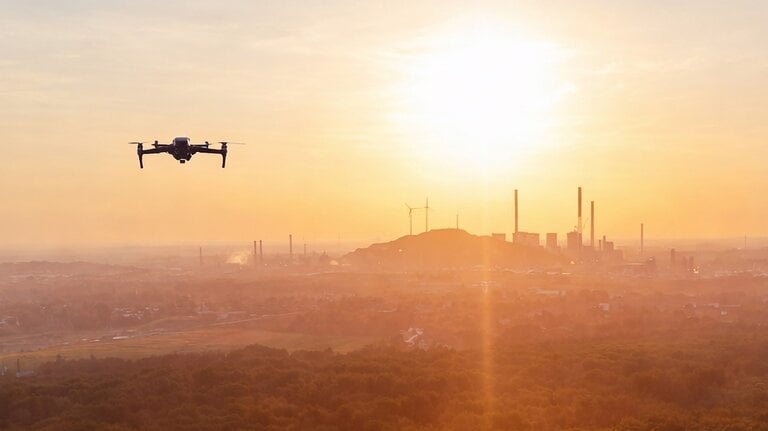
Detecting and intercepting drones: the solutions are already in place
How well are critical infrastructures protected against drone attacks? The security incident at Leipzig/Halle Airport has been a wake-up call for Germany. Until now, the threat from drones appeared to come from hobbyists. But now the Federal Public Prosecutor’s Office is investigating on suspicion of an attempt to cause an explosion using explosives and is describing it as a “serious attack on transport and logistics infrastructure in Germany”.
From unauthorised drone flights to a real security threat
Unauthorised drone flights have been a concern for airports and security authorities for years. According to its own figures, German Air Traffic Control (DFS) records a high number of drones every year that disrupt air traffic in the vicinity of commercial airports. This can result in delays, diversions or flight cancellations. Above all, however, the DFS warns that drones flying near manned aircraft can endanger passengers and crew.
And the number of sightings is rising. The news magazine *Der Spiegel* reports that 166 drones were reported at the 15 international commercial airports in the first half of 2026, citing figures from the German Air Traffic Control. In the first half of 2025, 101 cases were recorded.
These figures alone show just how prevalent drones have become in the vicinity of sensitive infrastructure. However, the incident in Leipzig/Halle takes the debate to a whole new level.
Calls for better protection are growing louder
At any rate, the need for action to protect airports and other KRITIS facilities has been recognised – as has the potential for debate. This is because drone detection and drone defence fall under different areas of responsibility. Some politicians are calling for simplification. For instance, operators of critical infrastructure are to be authorised to neutralise drones, something they are not permitted to do under current legislation.
But is Germany really so defenceless?
No. Solutions for detecting drones are available. German Air Traffic Control is also already supporting the relevant security authorities in introducing high-performance systems for drone detection and defence.
Operators of critical infrastructure must be able to detect and assess suspicious drone activity as early as possible and quickly feed this information into existing security and alert processes.
Integrating drone detection into existing security processes
Materna offers a concrete solution for drone detection for organisations with sensitive premises, distributed sites or operational processes requiring special protection. These include, in particular, energy suppliers, industrial companies, airports, public authorities, military barracks and operators of critical infrastructure. Even in temporary security scenarios, such as those surrounding major events, Materna can help to detect drone activity at an early stage and integrate it into a central situational awareness picture.
Sensor data is consolidated into a central SIEM site-wide situational picture, providing real-time visibility of drone activity across all sites. This enables incidents to be detected and categorised more quickly, and linked to existing security and alerting processes. At the same time, this enables timely and audit-compliant reports to be submitted to the security authorities. For critical infrastructure organisations, this provides an integrated approach to monitoring new threats effectively and transparently – as part of a holistic property security concept.
More than just monitoring airspace
However, it is not enough to focus exclusively on airspace. Marcus Götting, Head of the IoT Competence Centre at Materna, describes the challenge as follows: “KRITIS operators face the task of reliably monitoring extensive sites whilst reacting more quickly to security-critical events.”
However, traditional video surveillance only detects incidents in real time if security staff are monitoring the live stream. Modern cameras with edge AI do improve the situation through automatic object detection and fewer false alarms. But Materna’s SecuSite AI solution goes even further: the platform, specifically designed for KRITIS facilities, integrates video analytics, access control and other sensor technology to provide a consolidated situational overview.
By connecting control centres, workflows and ticketing systems, relevant events are not only detected but also integrated into existing security processes. The result: greater transparency, faster response times and a higher level of security.
Drone detection at the Resilience Readiness Day
To explore this topical issue in greater depth, Materna and ASW West are organising the Resilience Readiness Day on 10 September 2026. The event will bring together decision-makers from public administration, security agencies, the German Armed Forces, KRITIS companies and industry to discuss how national resilience can be shaped and implemented in practice.
A dedicated session will cover UAV detection, AI surveillance, sensor technology and auditability. The agenda includes, amongst other things, a UAV exposure check and a discussion of what the state and KRITIS organisations must take into account regarding drone detection and countermeasures within the current legal framework. The event will conclude with a look at networked resilience for logistics, as well as live demonstrations.