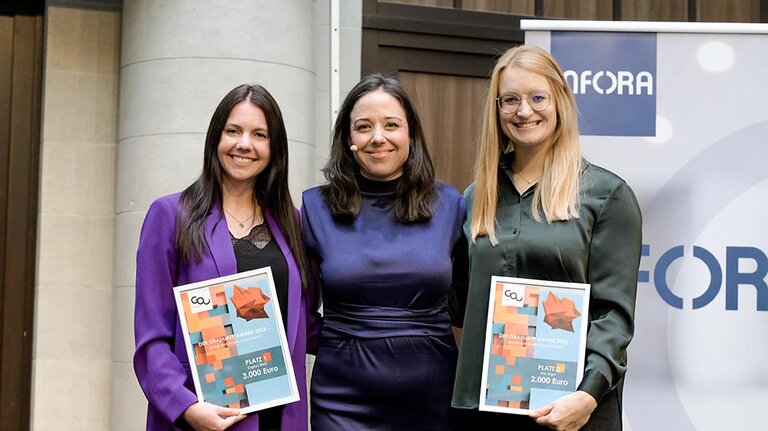
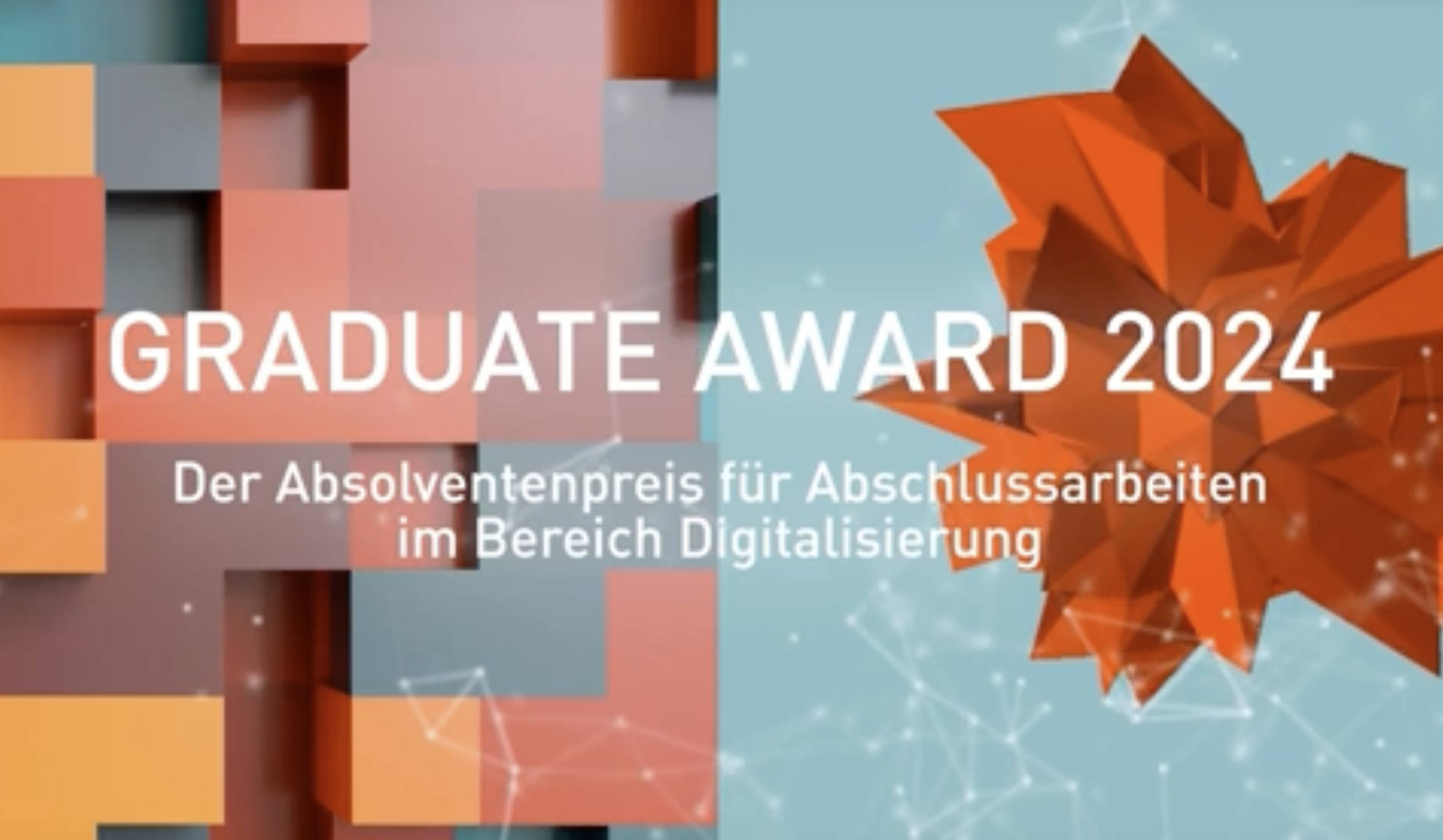
For the past five years, Materna has been presenting the Graduate Award for outstanding final-year dissertations on digitalisation in public administration. On 24 April, the 2024 awards were presented to the lucky winners during the Berlin User Days.
Particularly noteworthy this year was the prominent presence of the topic of artificial intelligence (AI) in the theses. It was encouraging to see how the students had engaged with the opportunities and challenges posed by AI in public administration. This was also reflected in the discussions and presentations during the Berlin User Days, which provided a dedicated platform for this important topic.
The rankings
1st place: Sophia Weß – The use of digital twins in public administration
In her Master’s thesis, Sophia Weß examined the use of digital twins in public administration, a concept that involves digital representations of real objects, systems or processes. Her focus was on the use of a digital mobility twin for local government applications. This innovative approach promises more effective public administration and improved services for citizens. The use of digital twins can lead to more precise simulation and analysis of urban processes, enabling decision-makers to make more efficient and data-driven decisions. In this way, resources can be better planned and managed. Furthermore, this approach offers the opportunity to improve the administration’s responsiveness to changing requirements and crises by enabling scenarios to be quickly simulated and adapted.
2nd place: Ina Jäger – Artificial Intelligence in public administration
In her Master’s thesis, Ina Jäger examined the application of artificial intelligence (AI) in public administration. Her study analysed three processes within a German public administration and identified potential use cases for AI. Of particular interest is the classification into three levels of AI deployment, ranging from heavily human-driven to fully AI-controlled. This classification makes it possible to develop bespoke solutions tailored to the specific needs of individual administrative processes. It also demonstrates how AI can function both as a tool to support human decision-making and as an independent decision-making body, allowing for flexible adaptation to different tasks and risk levels. These findings highlight the growing importance of AI in public administration and the opportunities it offers for making processes more efficient.
3rd place: Jan Dohn – Cloud computing in German public authorities
In his bachelor’s thesis, Jan Dohn explored the topic of cloud computing and its use in German public authorities. Focusing on the introduction of Microsoft 365, he examined how the public sector can optimise its digital processes without adopting inefficient or outdated methods. His research findings provide important impetus for a forward-looking and sustainable digitalisation of public administration. The thesis demonstrated how cloud solutions can help boost efficiency by offering a scalable, flexible and cost-effective infrastructure that can be adapted to the changing requirements of public authorities. Overall, the introduction of Microsoft 365 in public administration represents a significant step towards modernising administrative work and promotes the development of more transparent and citizen-friendly services.
The prizes were presented in recognition of the students’ commitment and outstanding achievement. The Graduate Award is not only an opportunity to reward talented individuals, but also a sign of Materna’s ongoing support for the development of professionals in the field of digitalisation within the public sector.
We are delighted with the high number and quality of entries submitted this year and would like to thank all participants for their contributions. The success of the Graduate Award reaffirms our belief that the future of public administration lies in the hands of talented and committed individuals. We will be continuing the Graduate Award next year as well. The application period for the 2025 Graduate Award will begin in late summer or early autumn.