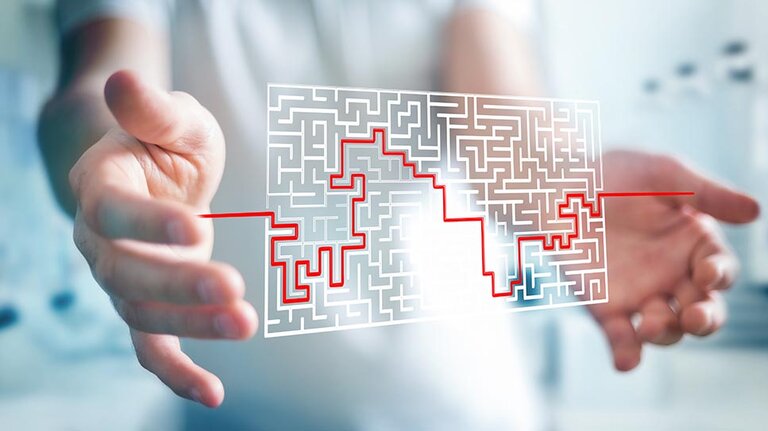
Nowadays, public authorities are increasingly receiving applications in digital form, and decisions are issued digitally. However, too much time often elapses in between, as processes still run into problems at many interfaces and the parties involved are not yet fully digitally connected, even to existing online portals. Firstly, applications must be routed to the correct contact person; data must be processed further and transferred to, or integrated with, specialist applications or registers. Further steps include case and file management, as well as the legally compliant storage of documents. A single process often involves numerous internal case handlers as well as case handlers from other authorities.
End-to-end process digitalisation (E2E) aims to replace time-consuming manual or even paper-based procedures with digital solutions and then integrate them seamlessly – from the initial enquiry to the final outcome. At the same time – and this is equally an important aspect of end-to-end digitalisation – the expectations of both applicants and case handlers regarding modern, digital procedures should be taken into account and brought into line with the everyday experience of a digitalised world that is now the norm. Through skilfully designed digitalised processes that meet expectations, public authorities become faster and more responsive; they can scale these processes more effectively, save costs in the process and manage with fewer staff. They can also improve the quality of their services. Ultimately, citizens and businesses benefit from modern administrative services with shorter processing times.
Four steps to implementing end-to-end process digitalisation
Step 1: Examine existing processes closely and assess the status quo.
Where are there isolated gaps, such as system disconnects, media disconnects or barriers to collaboration? Which processes should be prioritised? What is the potential for digitalisation, what are the economic case for it, and what framework conditions are necessary for implementation? For our public sector clients, we carry out a detailed classification of the process and procedural landscape – for example, by application, control and participation procedures – and define corresponding solution features for individual, associated usage scenarios.
Step 2: Focus on specific, prioritised departments; develop solution scenarios and strategies for these; and establish the necessary framework conditions.
It is essential to think from the applicant’s perspective and to design the flow through administrative processes in a user-friendly manner, with a focus on the user experience. The human element must also be taken into account on the technical side of the process: unnecessary processing steps or unclear links between the actual processing and the relevant regulatory requirements make it difficult to improve the efficiency of digitised processes. So not all digital solutions are created equal.
Step 3: Well-digitalised processes hold the potential for reusability.
From a technical perspective, process building blocks should be identified and designed with reusability in mind. This always involves identifying which processes involve the same activities or sequences of steps. Identifying, standardising and reusing these is fundamental to the swift implementation of digital transformation. Within the context of end-to-end (E2E) process digitalisation, it is also necessary to adapt regulatory requirements, remove bureaucratic hurdles and improve interdisciplinary collaboration. For successful end-to-end process digitalisation, the involvement and feedback of all stakeholders, as well as ensuring the project is viable, are crucial.
Step 4: Selecting the right technology or platform that meets the specific needs of the administration and can be integrated into the existing IT landscape, as well as the technical implementation of the processes.
There are various approaches to digitalising processes in a bespoke manner: building on basic services (e.g. form management systems, e-file/DMS products), application-specific approaches (e.g. via specialist procedures), software development (e.g. fully bespoke development or using low-code approaches), or via specific service management platforms. For all these variants, there are highly modular, platform-based or even combined solution architectures.
A genuine option: integrating service management platforms
The use of service management platforms is an unconventional yet innovative approach to end-to-end (E2E) process digitalisation in public authorities. For example, case officers can view the entire process – including all activities and documents, as well as regulatory support – directly and at a glance within an enterprise service management system. These platforms operate independently of domain-specific solutions, yet are simultaneously capable of integrating with and interoperating with existing third-party FMS or DMS systems, such as the Lucom Interaction Platform or nscale eGov. This means that no re-implementation is required.
A general API interface is often sufficient for connecting to service platforms. Outdated IT systems and the need to adapt them are, alongside technical complexity and a lack of project capacity, one of the main reasons why end-to-end process digitalisation faces technical hurdles.
CONCLUSION: In any case, it is worth pursuing the end-to-end digitalisation of processes in public administration, regardless of central initiatives or legislation. This is because it is not merely a ‘nice-to-have’, but a necessity for operating efficiently, in a modern manner and in a user-centred way: a benefit for citizens, the business community and administrative staff alike.
You could find out more about this, along with illustrative examples and proposed solutions, from Thomas Diefenbach, Head of the Digital Strategy & Solutions Unit at our partner Infora GmbH, and Dr Alexander Fronk, Head of Business Development for the Public Sector at Materna, in the webcast held recently.
Missed the webcast? We’d be happy to provide you with the recording of “End-to-End Process Digitalisation”. Simply send an email to: [email protected].