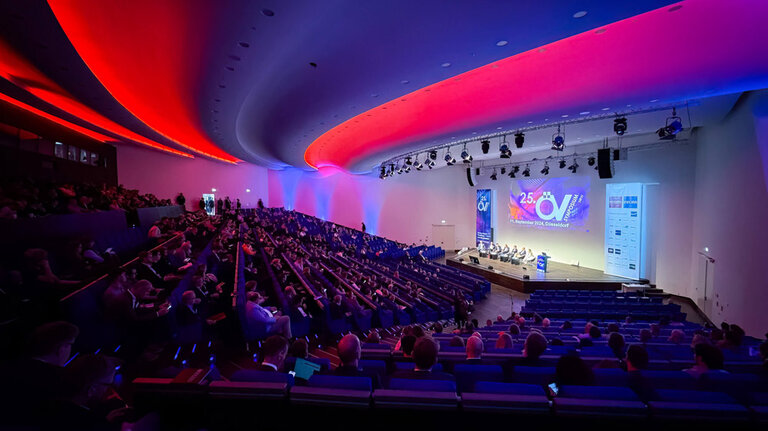
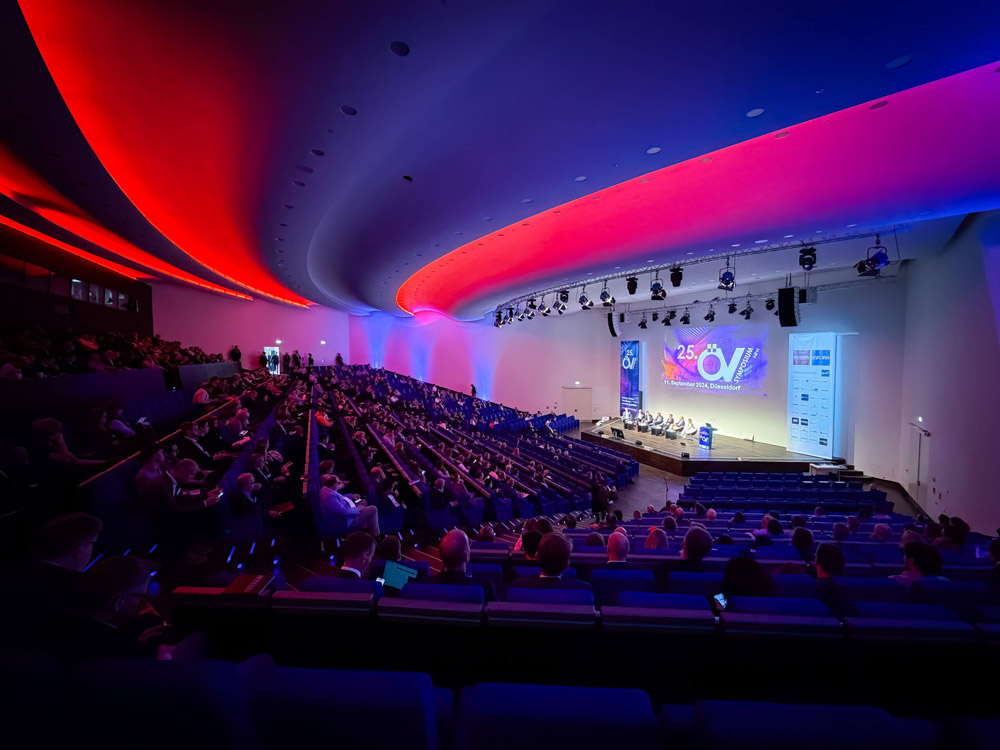
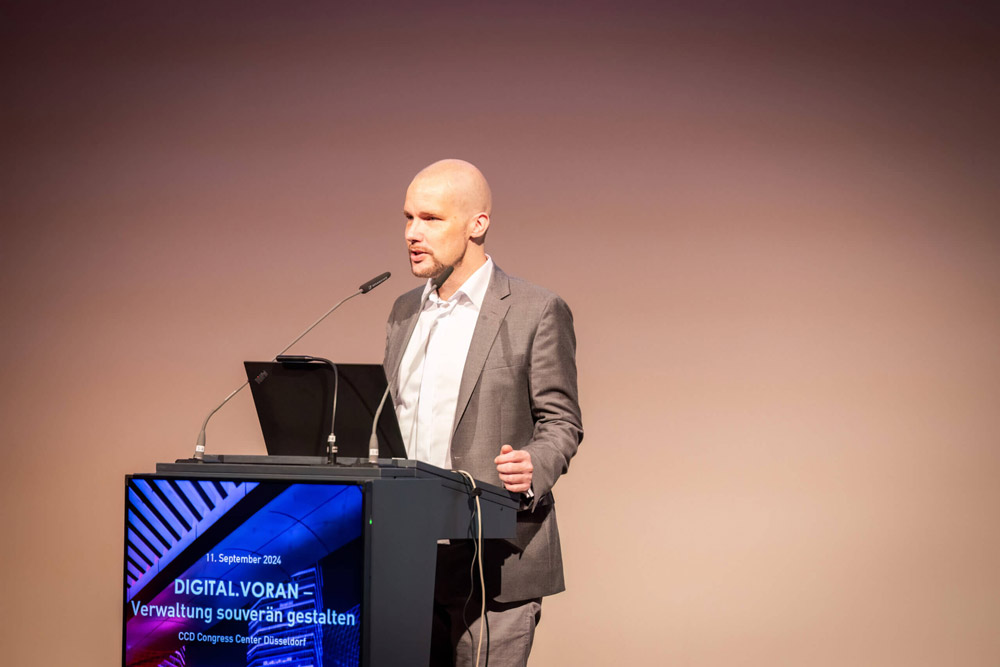
This year, our theme was “DIGITAL.VORAN – Shaping public administration with confidence”. Numerous experts spoke and discussed, amongst other things, the challenges and opportunities presented by artificial intelligence (AI) and the importance of digital sovereignty for public administration.
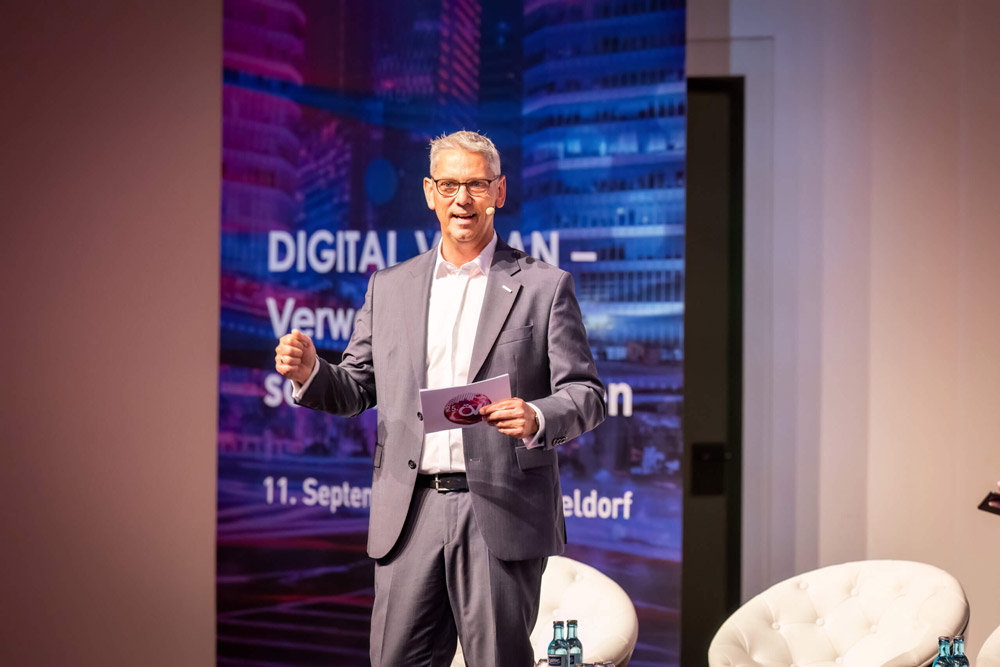
But first, as part of the welcome address by our host Michael Hagedorn, CEO of the Materna Group, we took a look back over the last 25 years. A retrospective video took us back to the early days: the inaugural event took place on 9 November 1999 in Neuss under the theme ‘Opportunities for a lean state’.
Some of the challenges faced in the early days remain key issues today – such as the e-file, which continues to play a central role in administrative processes. The ÖV Symposium has grown steadily, both in terms of participant numbers and exhibitors. The accompanying exhibition, which was small in the early years, featured 35 exhibitors this year. In particular, the exchange of practical experience has always been at the heart of the ÖV Symposium and has ensured a high annual turnout of visitors.
One key topic has been on the agenda of the ÖV Symposium since last year: the growing importance of AI. The ÖV Symposium provides the ideal setting for discussing the use of AI in public administration and for developing practical applications.
Local government: opportunities and challenges
Andreas Wohland, Deputy Secretary-General of the Association of Towns and Municipalities of North Rhine-Westphalia and representative of the leading local government associations, delivered a keynote speech on the role of digitalisation in local government. In his opening remarks, he emphasised the particular significance of the Public Transport Symposium: “In the Rhineland, anything that takes place for the third time is a tradition; anything that takes place for the fifth time is a custom. So something taking place for the 25th time is, in fact, already a historic event.”
In terms of content, Wohland addressed the pressing challenges facing local authorities, in particular the shortage of skilled workers and data security. He also noted that local authorities are heavily reliant on standardised solutions, as bespoke solutions are still too widespread in many areas and hinder efficiency. Another key theme in his speech was cyber security. Given the increasing number of cyber attacks, which also affect public institutions, data security must be a top priority.
AI made in Germany: possibilities and limitations
One of the highlights of the morning programme was the keynote speech by Jonas Andrulis, CEO and founder of Aleph Alpha. Speaking under the title ‘The Foundation of a New Generation of Public Administration’, he discussed the progress and challenges in the field of artificial intelligence.
With “PhariaAI”, Aleph Alpha is developing a specialised AI solution for the public sector. Aleph Alpha’s technology is particularly relevant to public administration as it meets key criteria such as the traceability of results, transparency and openness. It supports digital sovereignty and, consequently, data sovereignty. Andrulis emphasised that the partnership between Materna and Aleph Alpha offers great potential for further driving forward digitalisation in public administration: “We want to enable you to use this technology to initiate a transformation.” Aleph Alpha is building a new generation of knowledge work and administrative processes.
Roundtable: Sovereignty in Digitalisation
Another key element of the public administration symposium was the roundtable, at which experts Michael Hagedorn, Georg Lucht (MHKBD), Andreas Wohland, Dr Johannes Velling (MWIKE), Knuth Molzen (T-Systems) and Richard Bürmann (CGI) discussed, in particular, the topics of sovereignty and data protection in digital administration.
The topics ranged from sovereignty in the handling of data and technologies to data protection, which plays a particularly important role in public administration. Further points of discussion included the current possibilities for the use of AI, the role of humans as decision-makers, and the question of how AI can be meaningfully integrated into the administrative environment.
A successful day full of insights
The 25th Public Administration Symposium impressively demonstrated that digitalisation and the use of artificial intelligence in public administration bring with them numerous opportunities. The morning was characterised by engaging presentations and discussions, which showed that the path to digital sovereignty is far from complete. AI offers immense possibilities, such as the automation of routine tasks, more efficient processing of applications and the improvement of decision-making processes through data analysis. With clear regulations and responsible use, this technology will realise its full potential and significantly modernise public administration.
In the afternoon, the event continued with engaging workshops and presentations across four parallel specialist forums, where specific topics were explored in greater depth. At the same time, the focus was on intensive networking. Many participants exchanged ideas on innovative approaches and solutions for the digitalisation of public administration.
We would like to thank all our guests, speakers, exhibitors and everyone who helped out both on and off stage, and we look forward to seeing you again at the 26th ÖV Symposium on 24 September 2025 in Düsseldorf.