The project outline “Forest and Timber Data Space (DWH 4.0)”, developed under the leadership of Materna, has been awarded funding in the “Innovative and Practical Applications and Data Spaces in the GAIA-X Digital Ecosystem” funding competition. The Federal Ministry for Economic Affairs and Energy (BMWi) had launched the funding competition for collaborative projects with a minimum budget of ten million euros each and a duration of three years. A total of 131 consortia took part in the competition, with 16 projects receiving funding approval. The flagship project DWH 4.0 will launch in 2022 and will be implemented by a consortium comprising representatives from industry, public administration and academia, which is developing practical applications to connect the forestry and timber industries. The collaborative project will make the data space of the complex forest ecosystem available to a wide range of users. The aim is to model the forest as a digital twin, in particular to analyse the consequences of climate change for the forest and to enable sustainable use within the forestry and timber industry.
In Germany, over one million people are employed in the forest ecosystem across some 125,000 companies and are integrated into the value chain from seedlings to finished timber products. The ecosystem also includes more than two million private forest owners, who own around half of the total forest area. At present, the levels of digitalisation among the numerous stakeholders vary greatly. Discontinuities in data formats are common, networking is limited and standardised data formats are not widely used. There is significant potential to optimise the value chain and to collaborate in a more sustainable, secure and digital manner in future. There is currently no way to exchange data securely, reliably and digitally whenever required. This is precisely where the ‘Forest and Timber 4.0 Data Room’ comes in, addressing the issues of the data economy and sustainability.
“Sustainability and the data economy are key focus areas at Materna. It is particularly important to us to use our expertise and digital technologies to contribute to projects that promote the conservation and responsible use of natural resources. We are delighted to have been awarded the contract for the innovative GAIA-X funding project. Through the DWH 4.0 project, we will become a data provider for sustainable afforestation and forest management. Put simply, we can help ensure that forests are preserved in the long term as CO₂ sinks and sources of oxygen, whilst at the same time supporting the timber industry,” says Martin Wibbe, CEO of the Materna Group.
Innovative use cases for the Forest Data Space
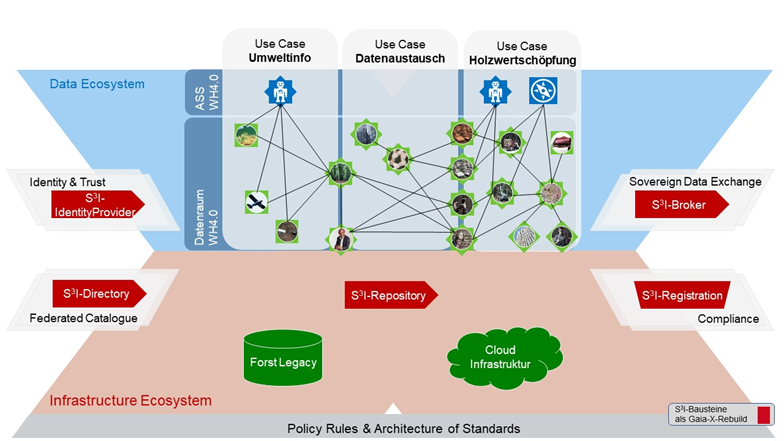
The project partners will further develop the digital ‘Forest Data Space’ into a federated, open and interoperable ecosystem, guided by the principles of the European GAIA-X initiative. A federation services platform is being developed which will open up the previously closed data silos of all stakeholders and make them available for the use of smart services. To this end, the DWH 4.0 funded project will map the entire process, from planting and forest management through to timber harvesting, timber logistics and timber processing. This will be demonstrated in prototype form using three use cases that the project partners are developing jointly:
- The first use case concerns the data-driven, sustainable management of forest stands. The technical integration of various forest data sources enables a comprehensive and detailed overview for forest monitoring.
- The second use case focuses on data exchange for privately owned forests. The ecosystem comprises forest owners, forestry service providers, forestry contractors, government funding bodies and the timber industry. An efficient, secure, trustworthy and user-friendly platform is to be provided for the exchange of sensitive data.
- The third use case concerns the collaborative and integrated timber value chain. Data sources that have not previously been digitally accessible are to be made available via the data room, and the end-to-end digital exchange of data between partners in the value chain is to be realised. Domain-specific data includes, for example, forest stand, terrain, track, timber, machinery and logistics data.
Technological foundations
Extensive technological foundations are available for the implementation of this ambitious project. These include reference implementations from the Mobility Data Space (MobiDS) joint project, as well as the Federal Highway Research Institute’s mobility data marketplace, which, as a data trustee platform, serves as the national access point for multimodal mobility data. Both already possess functionalities comparable to the GAIA-X target architecture. The work also builds on a basic communication structure that has been tried and tested in the timber industry, which partners from RWTH Aachen University and RIF e.V. in Dortmund are contributing to the project.
Materna is a Day One Member of GAIA-X AISBL and a member of several GAIA-X Hub working groups, and brings to the funded project over ten years’ experience in implementing mobility data spaces, as well as expertise in the implementation of data-driven applications. “We employ an interdisciplinary team of business developers, industry and technology experts. Our services range from the development of a data-driven digital vision or mission, through initial pilot projects and collaborative initiatives, to the roll-out within federated and sovereign European data infrastructures,” explains Thomas Feld, Head of the Data Economy Department at Materna.
Business and public administration working together
The consortium partners are Materna SE, RIF Institute for Research and Transfer e.V., RWTH Aachen University, Society for Navigation and Logistics Support in the Forestry and Timber Industry mbH, foldAI, LOGIBALL GmbH, HSM Hohenloher Spezial Maschinenbau GmbH & Co. KG, ABIES ITS GmbH, the Gotha Forestry Research and Competence Centre (ThüringenForst) and the State Forestry and Timber Agency of North Rhine-Westphalia.
“With the Forest and Timber Competence Centre KWH 4.0, we have already carried out crucial groundwork to enable, through the planned DWH 4.0 project, secure and trustworthy digital data exchange at the touch of a button for a sustainable and climate-friendly forestry and timber industry,” says Prof. Jürgen Roßmann, Executive Director of the RIF and Professor at the Institute for Human–Machine Interaction at RWTH Aachen University.
In addition to North Rhine-Westphalia, represented by the State Forestry and Timber Agency NRW, the states of Thuringia, Saarland and Bavaria are also participating in this cross-state project, which will be implemented from 2022. On the business side, both forestry companies and mechanical and plant engineering firms are involved as data providers.
The private sector and public administration are working together on this flagship project to promote greater sustainability and the data economy, giving the entire sector a boost towards digitalisation. This is creating new marketing opportunities for both data owners and data users.