Reasons for using the Internet of Things
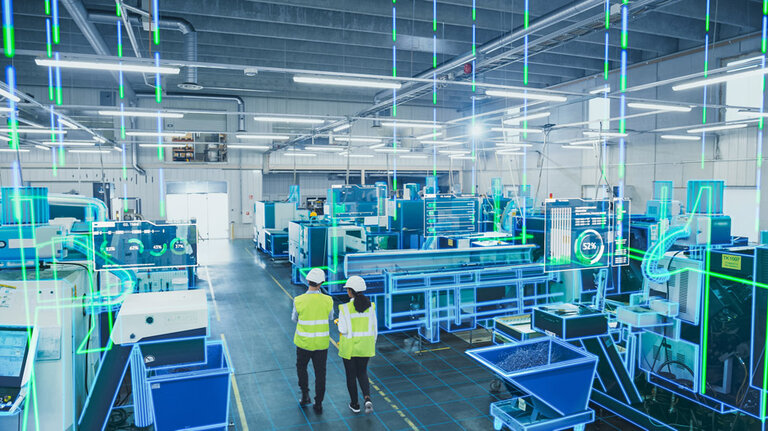
The digitalisation of industry has come to the public’s attention, not least through the buzzword ‘Industry 4.0’. There is talk of a data-driven industrial revolution that is creating new opportunities. The foundation of this revolution is the Internet of Things. Through its targeted use, it offers new possibilities that are taking hold at various levels of the production process.
IoT – where technology meets business
The use of IoT makes businesses more cost-effective. The data collected provides deeper insight into existing process chains. Superfluous or faulty process steps can be specifically identified and rectified. Equally important are environmental considerations, linked to the question of where action can be taken to reduce emissions. How can companies produce more energy-efficiently? This information, too, can be generated from the newly acquired data and utilised in a targeted manner.
Further reasons for using IoT include:
- Reduced maintenance times
- Improved production planning
- Clearer scheduling of staff, machinery and equipment
- Process automation, e.g. in the context of goods dispatch
- More accurate stock management with more precise demand and stock planning
Reasons for using IoT outside one’s own production
Not only the machines within production but also the goods produced can be fitted with sensors for intelligent use. The data received makes it possible to optimise the quality of one’s own goods – be they machines or devices. At the same time, companies create added value that increases customer satisfaction and, consequently, customer loyalty. This includes:
- Insights into quality assurance from the customer’s perspective
- Optimised use of consumables
- Improvements to customer service
Particularly when it comes to improving customer service, new processes are emerging that the Internet of Things makes possible for the first time. These include automated delivery processes (e.g. for tools or spare parts), the development of more comprehensive knowledge databases, streamlined support workflows and much more.
In addition to the reasons mentioned, there are many others that make investing in the Internet of Things a sound decision. To ensure these ultimately translate into benefits, it is essential to deploy IoT in a targeted manner.
Integrating the Internet of Things in a targeted manner
The aim of using IoT should always be to meet or exceed existing business objectives. In doing so, it is important that companies always tailor the IoT to their own specific applications, business objectives and business models. To reap the full benefits of IoT in this context, a phased introduction of the new technology is advisable. This not only enables the gradual optimisation of a company’s own processes, but also allows for the planning and development of new business models that drive corporate growth. Based on experience gained from customer projects, Materna has established a five-stage model that always takes the current state of an individual customer’s situation as its starting point:
Stage 1: Traditional products
The first stage starts at the very basics. At this point, neither machines nor products are connected to sensors, so no data can yet be read. Relevant KPIs can, for example, only be measured by the number of goods produced. Take the car as an example: from the perspective of a traditional product, it is merely a means of transport. With the aid of simple displays and without any unnecessary built-in technology, its sole purpose is to travel from A to B.
Stage 2: Reactive Remote Service
In the second stage, machines and products are fitted with sensors so that they can continuously transmit data. It is important to determine where the data should be collected. Given the large volumes of data, a cloud-based solution is a suitable option, for example, as it is scalable and can grow as the system expands. At this stage, a manufacturer can analyse the data collected as required, enabling a reactive service to be provided.
In the example of a car, it would now be able to read out faults remotely. This means that – in the event of a breakdown – the garage can quickly identify the source of the fault and order spare parts if necessary. The repair itself can also be carried out more quickly on the basis of this data.
Stage 3: Proactive Remote Service
At this stage, the data collected is not only gathered but also analysed using appropriate software solutions. From this stage onwards, predictive maintenance becomes possible, enabling a manufacturer to detect faults in good time or to intervene promptly in the event of increased wear and tear.
To stick with the car example: before a breakdown occurs and the vehicle comes to an unexpected halt, indicator lights or warning messages alert the driver in good time. Even before the breakdown happens, sources of faults – such as wear parts – can be replaced, thereby ensuring a safe journey.
Stage 4: Data-driven service optimisation
Rather than merely detecting faults or maintenance issues, the IoT also makes it possible to carry out targeted checks on a device’s environment. Should any factors negatively affect the smooth operation of the equipment, these can be quickly identified and addressed. Ultimately, this amounts to an optimised service that enables further sources of faults to be identified and circumvented.
In the case of a car, this can also be illustrated using the example of reactive remote service described above. Based on the data, the vehicle owner or driver is immediately offered workshop appointments in the event of a fault. In this context, several faults can also be rectified at once. Looking ahead, this means that the vehicle owner will need to visit the workshop less frequently.
Stage 5: Development of a subscription model
The fifth stage makes it possible to develop entirely new business models – such as a subscription model – based on the intelligent solutions provided by the Internet of Things. These models offer companies the option of providing certain services for the use of a product, for example, via a subscription model.
This approach is also familiar from the automotive industry and is widely used. For instance, various manufacturers offer apps tailored to their respective car models. These apps provide services that become subject to a charge after a certain period of use. Further examples in this context include temporarily enhanced sat-nav functions or ‘tyres-as-a-service’. The latter could mean that a vehicle owner transfers responsibility for changing tyres or replacing them in the event of damage to the manufacturer.