Disadvantages of the traditional product business
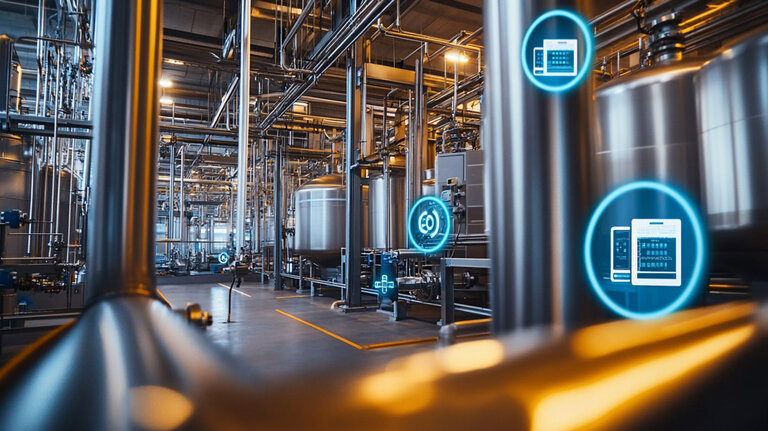
Traditional product business operates without any additional connected systems or services. The customer is solely responsible for the operation of their machinery, without relying on any further systems. In the event of a fault or maintenance, the machine comes to a standstill, which ultimately leads to production downtime and consequently to increased costs. As awareness of this shortcoming grows, customers’ expectations of manufacturers are rising. They are looking for digital, improved services and greater value.
Another disadvantage of the traditional product business lies in the ease with which existing products can be copied. As a result, innovations are quickly superseded by so-called ‘me-too’ products. These imitations make it increasingly difficult for manufacturers to maintain their market position in the long term. At the same time, manufacturers lack the means to extract information from existing products that would enable a better, digital service. IoT-based services offer companies the opportunity to address the weaknesses of traditional products.
IoT-based services – from traditional to smart product business
As part of the Smart Factory concept, machines are fitted with sensors that transmit data via wireless technologies. This data is analysed and utilised, for example within the framework of a digital twin. In this way, ‘ordinary’ production can be transformed into a so-called Smart Factory. The principle behind smart products works in a similar way: in this case, products are enhanced with customised IoT solutions so that they transmit data, as illustrated by the example of the robot vacuum cleaner in the first article in our series.
This approach opens up new perspectives for companies, which have an impact on how they approach their own market. This applies not only to the product itself. It also affects the services provided to customers as well as the development of business models. At the same time, existing challenges, such as those mentioned above, are addressed by supplementing products with IoT-based services. The exact impact of IoT-based services can be illustrated simply using the example of a car.
IoT-based services in everyday life – an example
Lane-keeping assist, automatic distance control, digital displays, radios and sat-nav systems are now familiar features in cars. Early warning alerts – ranging from low windscreen washer fluid to impending faults in the engine compartment – are only new in the sense that these warnings, issued before any damage occurs, can also be displayed on a smartphone via a dedicated app. Furthermore, car manufacturers and vehicle owners alike benefit from the vast amount of information made possible by connectivity via the IoT. This includes large volumes of data from various vehicles, which are used, amongst other things, to determine when potential gearbox faults might occur. This enables the manufacturer to know when warnings should or must be sent to customers. Customers benefit from a timely warning before any damage occurs.
These services are made possible by connecting the car to the internet, which facilitates various advances in development. Whereas, for example, when sat-navs first appeared, new maps always had to be laboriously installed via a garage and later by purchasing map CDs, they can now simply be downloaded and used straight away.
This connectivity with the services is already a major step forward. However, various manufacturers in the automotive industry are offering their customers even more: they provide apps that allow for a more convenient use of the product, as well as a better overview of its performance and, above all, enhanced safety features.
The benefits for the manufacturer, based on this example
By connecting the car to the internet, the manufacturer receives a constant stream of data on the performance and usage of its own products. This data can be utilised and analysed. This builds up an internal (knowledge) database that can be used in several ways: as a basis for further product development, to expand and relieve the burden on customer service, or even to develop new business models.
Data on their own customers’ driving behaviour can be incorporated into product development. By analysing this information, individual components can be optimised and driving comfort enhanced. It may also lead to the discovery of product innovations that, for example, promise reduced susceptibility to faults in wear parts. This makes it possible to increase customer loyalty and further secure the company’s market position.
The same is achieved by optimising customer service, whether by reducing the workload or expanding services. The data collected helps to quickly identify known faults and share this knowledge with garages via a centralised database. Workshops benefit from this, as the effort required for servicing and maintenance in the event of damage is significantly reduced. Customer satisfaction is also enhanced by this proactive approach – which, in turn, represents a benefit for both the vehicle owner and the workshop itself.
At the same time, this data makes it easier to identify and, consequently, address customer behaviour and needs by developing new business models. Manufacturers are already utilising this, for example, in the case of supplementary vehicle applications. For instance, services are made available free of charge for a specific period for testing purposes – although costs are incurred for continued use. This enables ‘X-as-a-Service’ models to emerge as new business models.