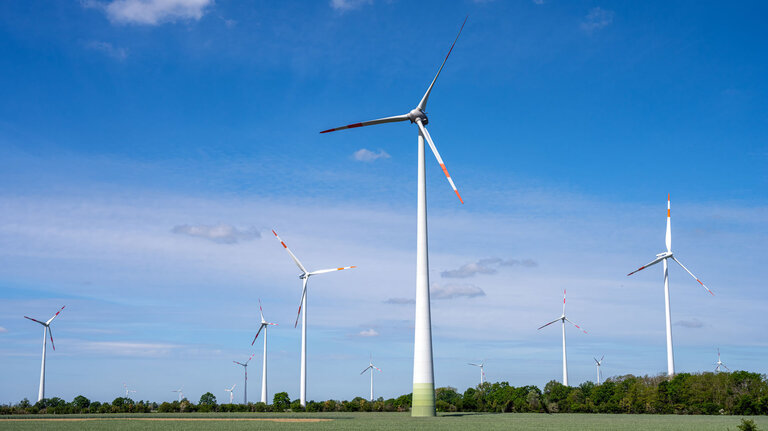
ENERCON GmbH is Germany’s largest manufacturer of wind turbines and a global leader in the sector. The Aurich-based company employs 13,500 staff across the group, 7,500 of whom are based in Germany alone. However, even in highly innovative companies, there are internal processes that are no longer able to cope with requirements that are becoming increasingly complex over time. The result: long processing times, redundant work steps and a lack of transparency regarding outstanding enquiries.
ServiceNow as the new, central platform
In light of these challenges, ENERCON decided to introduce an IT service management tool. ServiceNow was soon identified as the right tool: a highly available, scalable platform for digitising, automating and optimising processes. However, to actually deliver standardised services and map user-centric processes via a single portal, it quickly became clear that ENERCON would need the support of external partners.
With ServiceNow, ENERCON now has a central platform on which all enquiries can be recorded, tracked and prioritised. Processing is structured and transparent, which makes the work considerably easier for everyone involved. The introduction of automated workflows has replaced many of the previous processes, meaning that requests are processed more quickly and automatically forwarded to the correct departments.
By automating many work steps, processing times have been significantly reduced. The IT teams can now focus on more complex tasks rather than being bogged down by administrative work.
Thanks to the new platform, reporting and monitoring have also been significantly improved. Managers and service teams can see at any time how many tickets are outstanding, how long processing takes and where there is still room for improvement. This enables ENERCON to make data-driven decisions and work continuously on improving its service management.
The decision to choose ServiceNow and the role of agineo
“agineo has advised us, helped with the development work and is always our first point of contact when assessing which new requirements can be usefully implemented within the agile process. This also includes putting the brakes on when, for example, customisation would not have an optimal long-term impact on our project,” says Cláudia Bispo, Head of the Service Desk Department at ENERCON.
Together with ENERCON, agineo’s experts analysed the existing IT processes, identified weaknesses and defined the requirements for a high-performance and future-proof system. Particular care was taken to ensure that ServiceNow could meet Enercon’s specific needs and integrate seamlessly into the existing IT landscape.
The implementation of ServiceNow was therefore carried out in stages. This is because a key advantage of ServiceNow is the platform’s scalability. This ensures that the company will benefit from the new solution in the long term. In addition, data from the various legacy systems was integrated into ServiceNow to create a unified database.
The importance of Materna TMT in change management
Reducing concerns and alleviating fears – the introduction of a new system always brings about changes that are not immediately welcomed by all staff. To ensure a successful transition to ServiceNow, Materna TMT – a Materna subsidiary specialising in change management, training and digital learning – supported the project with targeted change management measures.
A key step was early communication with the teams affected. Materna TMT analysed the existing corporate culture, identified potential resistance and, building on this, developed training courses and workshops. On the one hand, staff familiarised themselves with the technical functions of ServiceNow; on the other, Materna TMT used multimedia e-learning modules to convey the necessary knowledge and explain the benefits for day-to-day work.
Regular feedback sessions ensured that concerns were taken seriously and that the system could be optimised step by step.
The project timeline
The roll-out of ServiceNow is being continuously developed to integrate additional processes into the platform. Following the test phase and fine-tuning, the go-live took place, followed by an optimisation phase during which final adjustments were made. Around 300 IT staff and external partners worldwide are now working with the new solution.
Also of interest:
Digitalisation of the energy sector