19.03.2026
Blog
Enterprise Service Management

ESM Connect 2026: The problem isn’t the technology

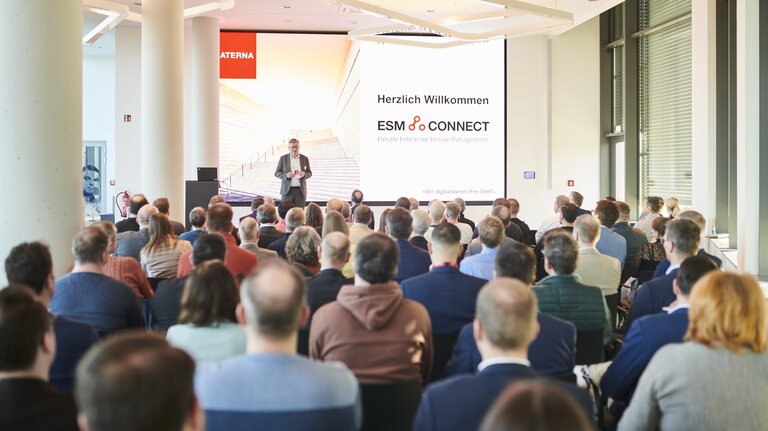
Most companies do not have a technology problem when it comes to service management. They have a structural problem. Platforms are in place. AI is available. Tools are more powerful than ever. And yet many organisations are still failing to realise their full potential. Why this is the case – and what fundamental changes are currently taking place – became clear at ESM Connect on 25 February 2026 in Dortmund.

Bianca Gollan
Business Partnerin Cross Market Services und Enterprise Transformation

Key takeaways

  • AI only delivers benefits if the organisation, data and processes are right.
  • Platforms and end-to-end structures form the basis for successful services.
  • ESM is becoming a strategic lever for efficiency, transparency and customer value.

Platforms determine controllability

A key theme ran through several presentations: platforms are no longer part of IT strategy. They are its very foundation. TransnetBW demonstrated this very clearly. In an environment characterised by system security, real-time data and regulatory requirements, established structures are reaching their limits. Platforms do not merely create efficiency here – they make control possible in the first place. The crucial shift is this: it is not the organisation that determines the platform – rather, the platform increasingly sets the framework for the organisation and its processes.

Transformation rarely fails because of the tool

The case study from thyssenkrupp Uhde also confirmed a well-known but often underestimated pattern: transformation rarely fails because of technology.

The focus was on a global ITSM transformation – with a clear emphasis on:

  • end-to-end services rather than siloed structures
  • clear service accountability
  • a robust, consistent data foundation

The key point is this: only once these foundations are in place do technologies such as AI realise their true potential. Or to put it another way: without structure, AI remains a promise of efficiency without any real impact.

ESM becomes the regulatory framework

Systemhaus Dresden GmbH (SHD) presented a perspective that is currently a key concern for many organisations: how can a system landscape that has evolved over time be transformed into a manageable, integrated system?

The answer lies not in adding complexity, but in reducing it. Simplification, standardisation and a clear focus on business value become the key levers. This also changes the role of ESM. It is no longer just about operating services – but about making organisations manageable.

AI is transforming leadership – not just processes

The keynote speech by Nina Moeller from Materna TMT prompted a deliberate shift in perspective. Her key question: “What if our next employee weren’t a human being?”

The real message behind this is that AI is changing not just processes, but the very logic of organisations. In this context, leadership means:

  • providing direction rather than micromanaging processes
  • Defining scope for decision-making rather than prescribing tasks
  • being able to deal with uncertainty

Technology thus becomes a leadership issue.

SAP Solution Manager: From a replacement project to an opportunity

The discussion surrounding SAP Solution Manager also serves as a prime example of where many companies currently stand. Dr Carl Christoph Winter of cbs Corporate Business Solutions Unternehmensberatung GmbH and Dr Kai-Uwe Winter (Materna) made it clear:
anyone who views the replacement as a purely IT project is squandering potential. In fact, it is an ideal opportunity to rethink ALM, ITSM and ESM – in an integrated, strategic manner and guided by clear objectives.

Implementation is no longer a topic for the future

Moris Orodu from Materna demonstrated in a live demo of BMC Helix that all these developments are by no means theoretical. AI-powered services can already be deployed in production today. The real challenge no longer lies in the availability of technology – but in its consistent integration into the organisation, processes and data structures.

What is really changing right now

Above all, ESM Connect has made one thing clear: the focus of the discussion has shifted. It is no longer about individual tools or best practices.

It is about fundamental questions of governance:

  • How do organisations become compatible with platforms?
  • How can genuine end-to-end accountability be established?
  • And how can AI be meaningfully integrated – beyond pilot projects?

The answers to these questions will determine how effective service management will be in the future. Or to put it more bluntly: it is not the technology that is the bottleneck, but the way we think about organisation.


Further information about the ESM Connect event is available here. 

Highlights

Bianca Gollan
Business Partnerin Cross Market Services und Enterprise Transformation

Bianca Gollan arbeitet seit 2012 bei Materna in der Abteilung Marketing und Communications. Die Diplom-Betriebswirtin ist Business Partnerin für das Ressort Cross Market Services und Enterprise Transformation und unterstützt in allen Bereichen der Kundenkommunikation.