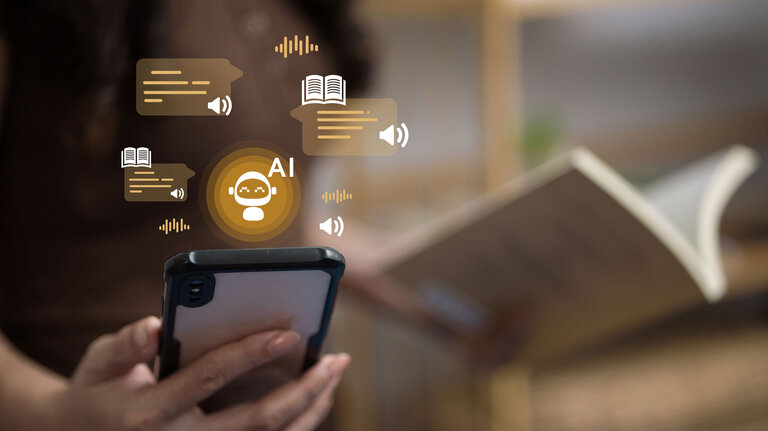
We’ve all been there: you need a service or some information from a provider, so you pick up the phone – but instead of speaking to a human, you hear a computerised voice. You have to listen to all the options for a whole minute, make a choice that you hope is the right one, and possibly navigate your way through further loops to reach your destination. This now decidedly outdated invention is called Interactive Voice Response (IVR) and is, ultimately, nothing more than an electronic voice menu.
Cumbersome to use – low user acceptance
IVR is extremely widespread these days – which is entirely understandable. After all, every company wants to handle regularly recurring standard enquiries before the resources of a human agent are called upon. Yet there is still plenty of room for improvement when it comes to user-friendliness. This is not only due to the static menu structure, which forces users to listen to all the options and laboriously navigate through the sub-menus, but also to the fact that user errors or long response times lead to cumbersome repetitions on both sides. The best example is longer sequences of digits, such as customer numbers or telephone numbers. Whilst the user is still laboriously reading out the customer number and entering it by pressing a key, it is not uncommon to hear: “I have understood the following number … ” Naturally, this is often still incomplete. So, back to the start.
For some time now, at least, it has been possible to say the menu options or digits out loud. Instead of, for example, pressing one for ‘My contract’, you can also say the number or the menu option ‘Contract’. Despite this innovation, IVR technology can no longer be considered up to date in today’s world. Callers want to obtain the information they need quickly and conveniently; companies want to ease the burden on their helplines. Instead of frustration caused by a lack of communication, what is needed is an exchange centred on natural language. And rigid structures must give way to dynamic dialogue. The solution: intelligent voicebots with AI-based technology.
Voicebots using natural language
Intelligent voicebots enable communication that is as natural as possible. This allows users to state their enquiry to the voicebot in their own words and, ideally, to speak in colloquial language. ‘May I free you from the dark world of IVR, dear caller?’ – ‘Oh, yes, of course! I’d love that.’
The bot recognises the user’s intention based on training data, which is compiled taking into account a wide variety of synonyms, alternative phrasing and different registers of speech. With competent AI training, a high recognition rate is achievable, even when callers speak in full sentences or use filler words such as interjections or other natural linguistic devices.
But the possibilities don’t stop at better recognition of individual expressions. It’s also possible to combine two requests at once using ‘and’ conjunctions. The intelligent voicebot remembers both intentions in context and processes them in the logical order. The voicebot’s AI also enables it to recognise when an expected sequence of digits has been completed. For example, if the bot expects an 8-digit customer number, it is not an excessively long pause in speech or input that ends the entry, but rather the complete number of digits expected – or the correct combination of letters and digits. Even verbal corrections during input are possible without any problems – just like in a real conversation.
AI-powered voicebots are not just the future, but already a reality
The era of IVR is over, thanks in part to young start-ups such as Parloa. We are currently in a beta phase with this Berlin-based company to test a voice bot with one of our clients. The evolution of voice-activated systems is long overdue. After all, over 70 per cent of users still prefer to pick up the phone when they have a service enquiry. However, most users are subsequently dissatisfied with the solution.
From a business perspective, the question isn’t really whether a voice bot should replace human agents – the voice bot is always cheaper. But only if this voice bot is actually good will it be accepted, and only if it is accepted will user satisfaction and the conversion rate increase.
If you’d now like to replace your IVR with a modern, AI-powered voicebot, please press the hash key – or get in touch with our Conversational AI Team.