17.08.2023
Blog
Digital Experience
Enterprise Service Management

Enterprise Service Management requires continuous improvement

Continuous improvement is essential if a company is to survive in a constantly changing environment. It is not enough to set up your processes once, or to only optimise them once things have already started to go wrong. Don’t let your potential for improvement go to waste!

Nadin Ebel
IT-Projektleiterin

Sustainability and success are based on continuous improvement. When introducing and establishing ESM processes within organisations, it is essential to ensure, right from the start, that continuous improvement becomes an integral part of the processes.

Measures aimed at optimisation – for example, in the form of an ‘ITIL project’ – should not be a one-off initiative. Otherwise, potential for improvement – such as better technical resources to provide efficient support and make employees’ work easier (self-service portals, chatbots, artificial intelligence, robotic process automation, etc.) – process streamlining or improved interfaces between processes, will be ignored. Organisations thus run the risk of failing to satisfy customers, users and even their own staff. In the worst-case scenario, all the benefits the organisation had hoped to gain from establishing these processes will be squandered. This not only represents a waste of time and money, but would also (once again) be a project that failed to achieve success. The reputation and role of IT as an enabler from the business’s perspective are undermined.

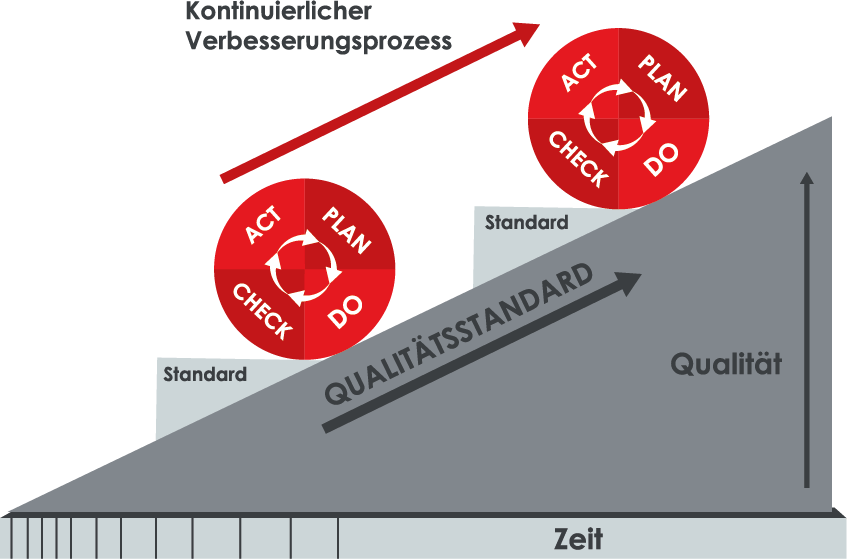
Kontinuierlicher Verbesserungsprozess

In light of changing influencing factors, new business requirements, technical developments and other drivers of change, it is essential to continue making improvements within one’s own organisation as part of the digital transformation. Sluggish organisations that resist change miss out on the opportunities that these changes offer.

In any case, expansion and improvements should be carried out in a structured manner, and the necessary coordination with ‘related’ processes should go without saying, in order to support successful and value-driven collaboration. After all, the requirements placed on processes and their environment are also constantly changing. Furthermore, it is unlikely that a perfect process or service can be introduced. Approaches drawn from lean management, for example, are far more suitable in process management. You can start pragmatically with a ‘minimum viable process’ or with an initial promising approach, and then adapt it in a structured and planned manner.  As Henry Ford once said: “It is not inventions, but improvements, that make a fortune”. 

Maintaining momentum in Enterprise Service Management (ESM)

Organisations should continuously and purposefully pursue ways to sustainably improve processes and services with a view to both internal and external customers. In doing so, they safeguard and strengthen investments in process and service management whilst increasing the satisfaction of staff, users and customers. Furthermore, they ensure that processes do not merely exist on paper, but that IT is actually able to deliver the value it is intended to provide. Continuous improvement paves the way for greater effectiveness and efficiency – and thus for a better value proposition for the customer.

This can be ensured, on the one hand, through holistic mechanisms within the IT organisation, such as certification. ISO 20000 certification for service management requires continuous improvement – just as, for example, ISO 9000 or ISO 27000 certification does. The planning and implementation of objectives for the processes are just as much a part of the ISO 20000 standard as the regular cycle of surveillance and recertification audits required to maintain certification. The standard requires processes that are measurable and therefore controllable. Improvements to the service management system must be demonstrated during the annual audits.

On the other hand, continuous improvement can also be understood and operate as a fundamental part of governance. This is possible when, for example, improvements to processes form part of strategic measures to achieve the organisation’s objectives, when operational objectives are pursued by those responsible for the processes, or when the development of processes is part of larger initiatives, such as in a DevOps context.

In many cases, the commitment of process owners, who wish to improve and simplify the process for ‘their’ users, plays an important role. Here, regular ‘user forums’ can help to identify and address specific needs. Digital surveys can also be used to gather feedback and identify opportunities for improvement. It is important that (iterative) feedback takes place and that momentum is maintained with an eye on the bigger picture.

This article was written by Nadin Ebel and Martin Bucksteeg from the Cross Market Services division.

Nadin Ebel
IT-Projektleiterin

Nadin Ebel arbeitet als IT-Projektleiterin, Beraterin für ITSM und akkreditierte ITIL-Trainerin. Sie verfügt über langjährige Erfahrungen in ITIL, Prozess- und Service-Management, IT-Infrastruktur und Projektmanagement. Sie hat sich zudem als Fachbuch-Autorin einen Namen gemacht.