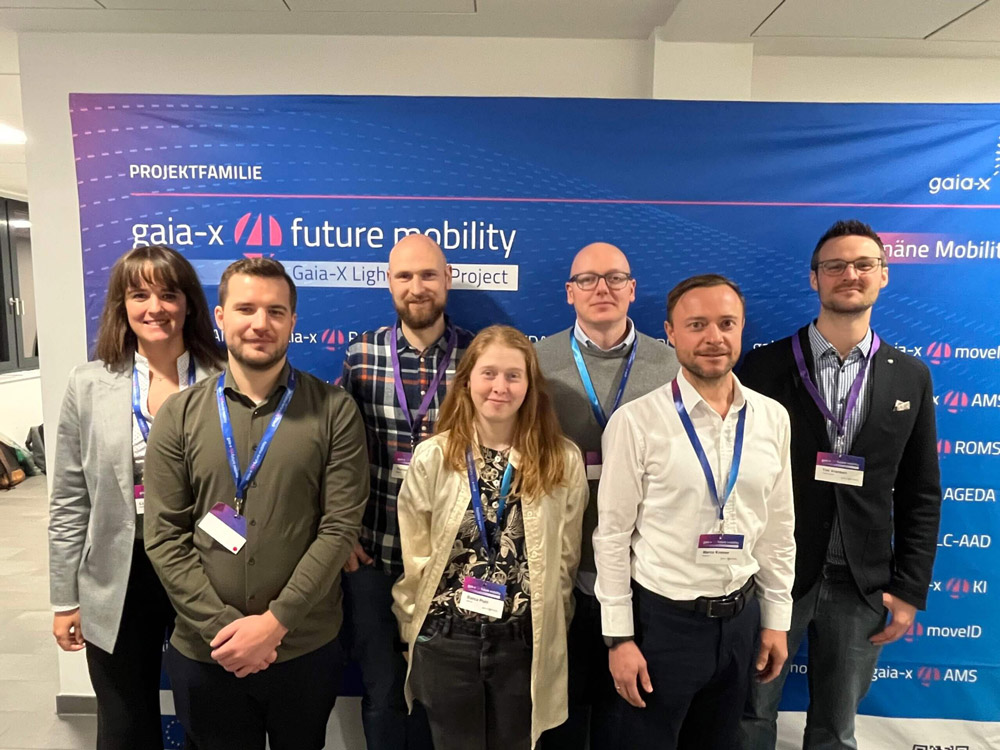
On 13 and 14 November, the closing events for Gaia-X 4 ROMS took place in Osnabrück and Hamburg after the project had run for over three years. ROMS stands for ‘Support and Remote Operation of Automated and Connected Mobility Services’. The project is one of six projects in the GAIA-X 4 Future Mobility family. The events offered participants not only theoretical insights but also practical demonstrations illustrating how Gaia-X technologies enable sustainable mobility and logistics solutions.
Materna and TraffGo, in collaboration with the Free and Hanseatic City of Hamburg and Verkehrsbetriebe Hamburg-Holstein (VHH), implemented the ‘Dynamic Stop Management’ use case. This identifies suitable stops for third-party providers (such as shuttle services) to better plan capacity utilisation, minimise stopovers, close gaps in the intermodal transport chain and create more attractive mobility services. In addition, Materna has worked with Zeppelin University to develop decentralised business models in the mobility sector, thereby helping to ensure the project’s long-term sustainability.
Innovations you can experience first-hand – the data room demonstrator
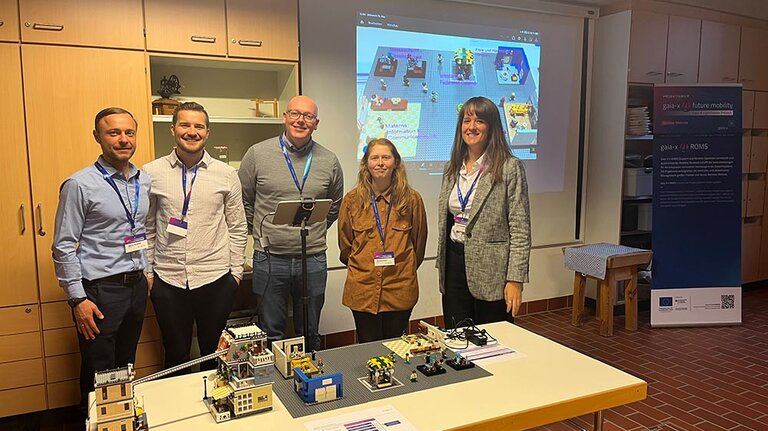
A highlight of the demonstrations at the closing events was the presentation of Materna’s data room demonstrator. “The demonstrator aims to enable the exploration and retrieval of information from various data sources in a visually appealing way,” says data scientist Marcel Koch, who was responsible for its implementation. The aim is to highlight the benefits of using data rooms and to make the application of such technologies tangible for a wide audience. This ensures that data exchange between different sources is not only efficient, but also reliable and secure – a crucial step towards a trustworthy and transparent data economy.
The demonstrator consists of three elements that complement each other seamlessly:
- Web application: A digital application that illustrates the process of participating in a data room step by step. Users learn how companies are registered and authenticated by providing specific data, and how this data can subsequently be made available securely and efficiently within a data room. The app explains the process using an analogy with a trade fair – from buying a ticket and registering to presenting products.
- Lego diorama: A physical model that visualises data exchange in a tangible and playful way.
- Augmented Reality (AR): AR enables users to explore the Lego diorama interactively. Animated scenarios demonstrate how data is exchanged and utilised within a secure data room.
This combination links innovative technologies with a clear, vivid explanation of complex concepts. In this way, the potential of data rooms becomes tangible and accessible to a wide range of target groups.
Closing event: Theory meets practice
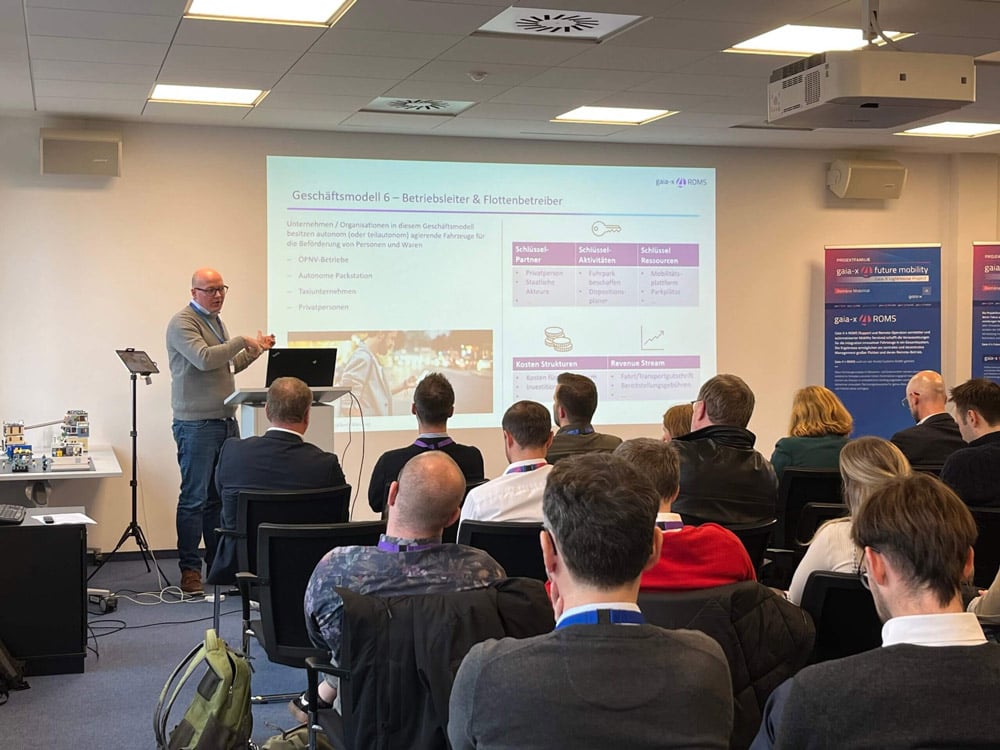
The closing events in Osnabrück and Hamburg offered a mix of inspiring talks, practical demonstrations and interactive workshops.
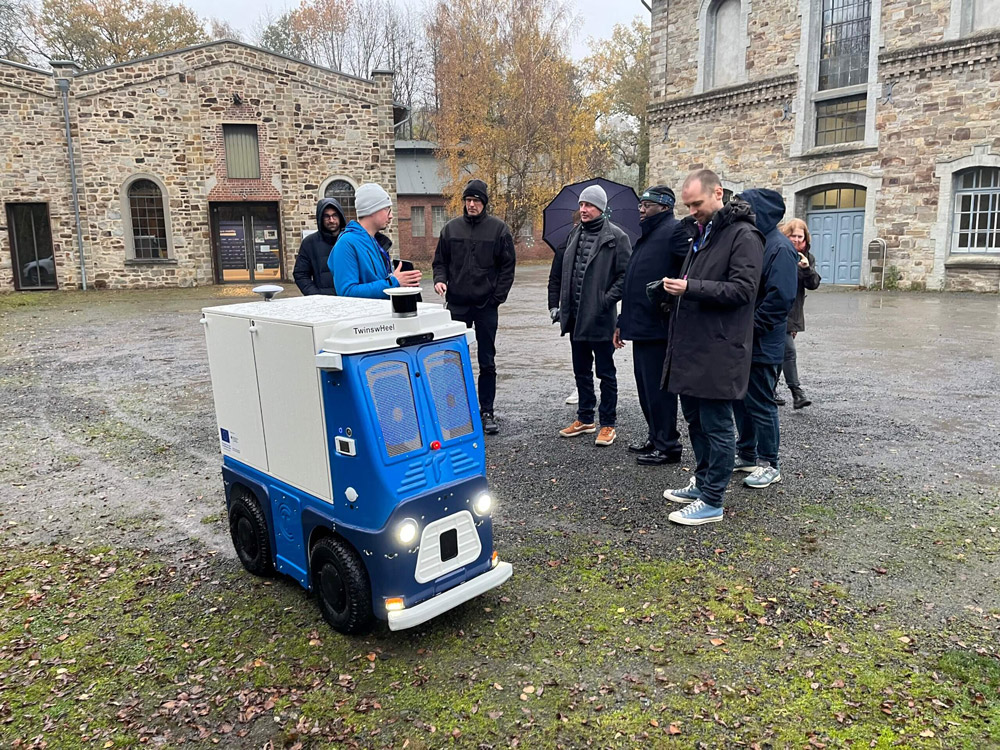
On the premises of Hamburger Hochbahn, participants were able to test an autonomous vehicle in real life. The “Smart Managed Public Transport Fleet” sub-project demonstrated how such vehicles can revolutionise local public transport in the future. Guests had the opportunity to take a test drive themselves and experience first-hand the combination of safety and efficiency offered by autonomous mobility solutions. The ‘Dynamic Stop Management’ use case, developed in collaboration with Materna amongst others, illustrates the coordinated multi-use of existing transport infrastructure, thereby improving solutions for the first and last mile. This use case was also presented this year at the Hannover Messe at the GAIA-X4Future Mobility stand.
Conclusion
The Gaia-X 4 ROMS project has impressively demonstrated how the European data infrastructure Gaia-X can bring about lasting change in the mobility and logistics sectors. Sovereign data spaces enable the secure and trustworthy exchange of sensitive data whilst simultaneously creating new business models.
Particularly impressive is the combination of theory and practice: Gaia-X 4 ROMS has produced concrete solutions that address real-world problems in mobility and logistics. The data room demonstrator illustrates how data-driven technologies can make processes more efficient whilst ensuring data protection and data sovereignty.
The insights and technologies developed over the past three years not only mark a step forward for research but also pave the way for real-world applications that could already become part of our everyday lives – be it through attractive mobility services and innovative business models, in the development of which Materna played a decisive role.
If you would like to find out more about dynamic stop management, you can read our blog post here.
Further information on the entire Gaia-X 4 ROMS research project can be found here.