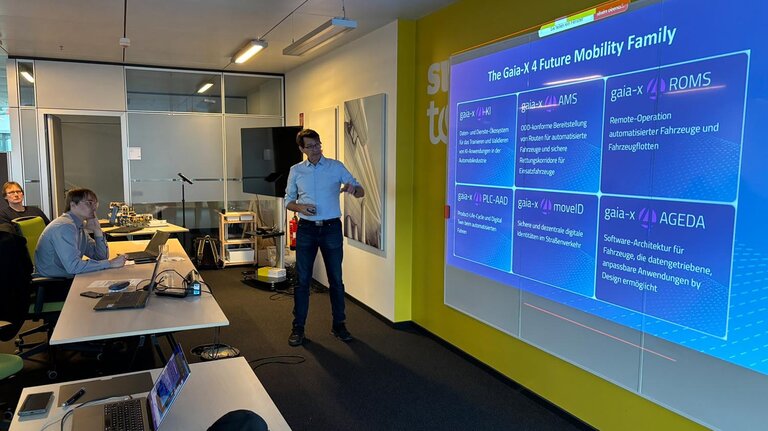
The aim of the Gaia-X 4 moveID project was to lay the foundations for a new data infrastructure in the mobility sector. From the outset, the focus was on ensuring that data sovereignty and control over data usage need not be ceded to centralised platforms (such as common hyperscalers). Rather, mobility providers, cities, service providers and users were to be enabled to exchange data amongst themselves – based on common standards, but without a central authority. This approach follows the principle of federation: All participants are loosely but bindingly networked with one another via technical and organisational standards. Each stakeholder decides for themselves with whom they share data and under what conditions. At the same time, digital identities and technically verifiable evidence ensure that trust can be established even in a decentralised environment.
The concept of data sovereignty is central to this: every organisation and every user retains full control over their own data. Through the use of so-called policies – that is, clearly defined access rules – and verifiable credentials – that is, standardised self-descriptions of the participants – access can be precisely controlled and automatically tracked. These principles ensure that the data space is not only secure, but also compliant with data protection regulations and conducive to innovation.
The use case: Smart Parking
Throughout the project, these abstract concepts were consistently linked to a practical use case: smart parking – the intelligent search for a parking space.
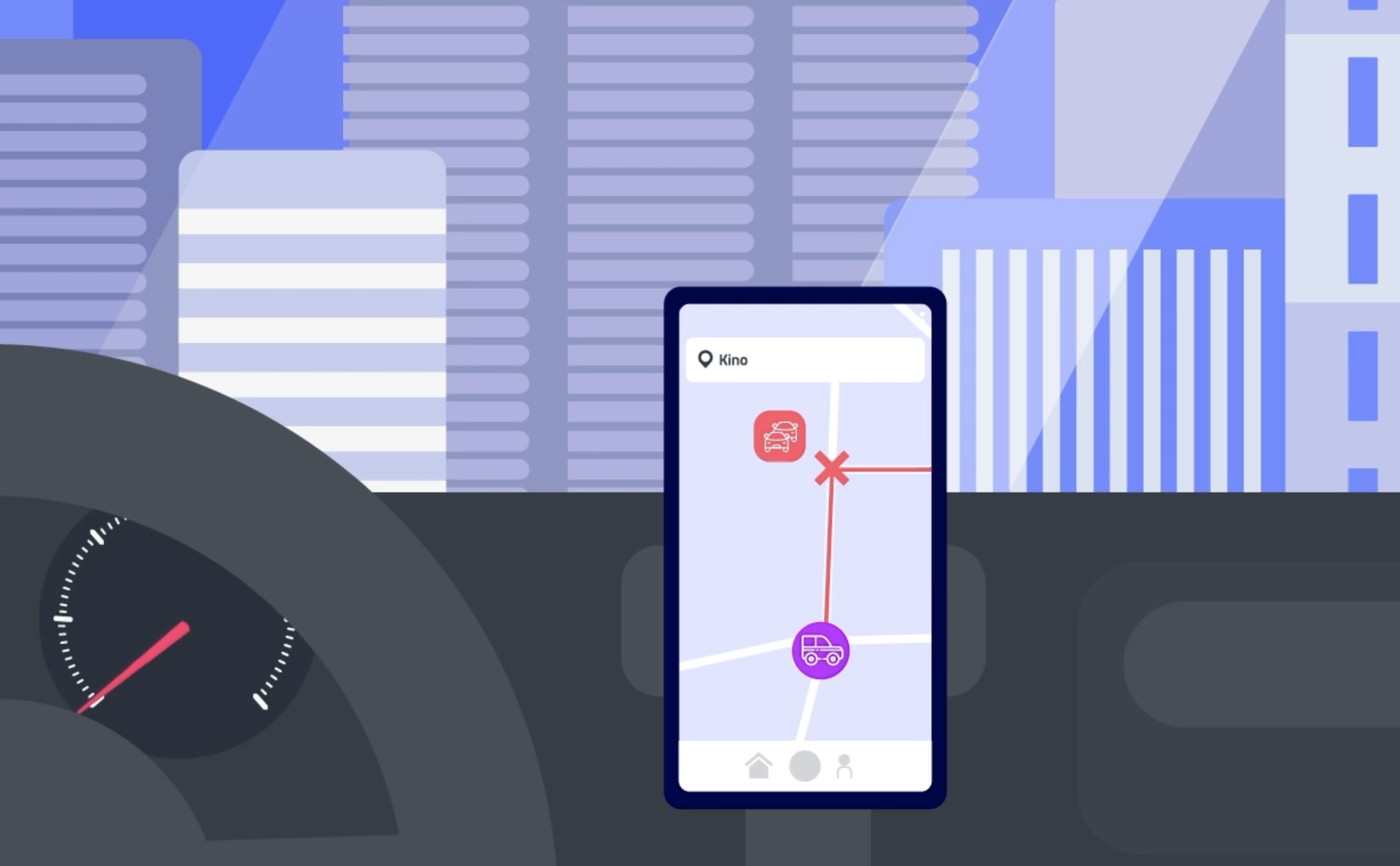
Here, the entire process – from entering a destination to selecting a car park – is supported by data-driven services. Users enter their destination via an app and, based on an AI model, receive a forecast of the occupancy levels in nearby car parks in the near future. The navigation system takes this information into account and guides the user directly to the most suitable car park. Should any disruptions or traffic jams occur en route, the route is dynamically adjusted – a re-routing prototype, developed by Materna exclusively using open-source components, enables precisely this flexibility and independence from comparable applications offered by hyperscalers. In addition, the car park search is enhanced by the integration of multimodal transport options such as public transport or car-sharing services – also based on interconnected data flows.
Technological foundations: open source and data sovereignty
All data used in this process is provided in compliance with Gaia-X, and its metadata is made available as so-called verifiable credentials. These are machine-readable and verifiable, thereby providing the basis for automated, trustworthy interactions between services, devices and users. The Eclipse Dataspace Components (EDC) Connector was used for the technical implementation of the data exchange. Materna operates its own instance for this purpose; a further instance was implemented by a partner. A bidirectional, secure data exchange takes place between the instances. At present, simple access policies are still in use; in future, these are to be expanded with finely granular rights to create even more targeted control options.
Materna has taken on a variety of roles in the project: contributing to the design and development of key components of the mobility data space and taking responsibility for the implementation of security and identity mechanisms – including governance frameworks and elements of digital identities. Furthermore, Materna played a key role in integrating the ‘Smart Parking’ use case, both into the technical data room architecture and into the prototype user application.
However, the end of the project is not a full stop, but rather a transition to the next phase. The results developed are now being transferred into production applications. The open-source technologies used, such as the Eclipse Dataspace Components, are to be further developed and tested in other contexts. The technical and organisational know-how gained is also being incorporated into tenders and consultancy services. This includes, for example, the SmartLivingNEXT project, which is establishing a sovereign data ecosystem for energy-efficient, secure and comfortable living. The findings are also being applied in the field of sustainability – for example, in the CO2ForIT project, which uses digital twins and AI to promote climate-positive business practices along the timber value chain.
Open ecosystem for mobility data
A practical example is the data platform operated by NRW.Mobidrom GmbH. This platform aggregates mobility data across the state, makes it available across all modes of transport and thus creates a technological foundation for new services and improved traffic management. The planned connection to the national Mobilithek also supports seamless, data-driven mobility throughout Germany.
Gaia-X 4 moveID has provided concepts and concrete solutions for this. Intelligent traffic management requires interconnected data, open standards and trust – and that is precisely what has been achieved here.