AI Security: Protection against a new generation of cyberattacks

Materna’s expertise ranges from risk analysis to defending against modern attack scenarios. We provide a comprehensive approach to strengthening your IT security.

AI Security – Protection against cyber attacks

Artificial intelligence optimises processes, but at the same time opens up vulnerabilities that are often particularly easy to exploit. Materna provides comprehensive support to businesses and public authorities in designing AI systems that are secure, compliant and resilient. We help you make your systems, data and models resilient against new AI-based attack methods.

Everything you need to know about AI security

AI Security encompasses the protection of AI systems against manipulation, data misuse and attacks – as well as the secure use of AI to detect and defend against threats.

AI Security refers to the use and protection of artificial intelligence in a security context. On the one hand, it involves protecting AI systems themselves against manipulation, data poisoning or unauthorised access. On the other hand, AI Security uses intelligent algorithms to detect threats more quickly, automatically fend off attacks and optimise security processes. The aim is a holistically secure, more resilient IT ecosystem.

AI shifts the focus from reactive to proactive security: it identifies patterns, anomalies and risks at an early stage and automates complex analyses.

AI is revolutionising the approach to security by making threat detection and response increasingly automated and proactive. Instead of merely reacting to attacks, organisations can identify risks at an early stage and take preventive action. By analysing vast amounts of data in real time, AI recognises even complex patterns and unknown attack vectors. This transforms cyber security from a reactive discipline into a learning, adaptive system. 

AI takes the pressure off analysts, prioritises alerts, detects unknown attack patterns and speeds up response times – making the SOC smarter, more efficient and more proactive.

AI makes SOCs and SIEM platforms significantly more powerful by automating routine analyses and reducing alarm floods. It helps minimise false alarms, identify unknown attack patterns and drastically shorten response times. Analyses that used to take hours are now completed in seconds. This transforms the SOC into an intelligent, proactive cyber security control centre. Security analysts retain strategic control. The result is a ‘human-in-the-loop’ approach, where AI supports the work of experts and makes decisions more informed, faster and more secure.

Prompt injection is an attack technique in which AI models are tricked into performing undesirable or malicious actions through manipulated inputs (prompts). Attackers attempt to circumvent the system’s original instructions – for example, to disclose confidential information, bypass security policies or alter the AI’s behaviour. Prompt injection is considered one of the key emerging threats in the field of generative AI and requires specific protective measures such as input filtering, context validation and continuous monitoring.

Specific threats: when intelligence becomes a risk

AI opens up new avenues for cyberattacks. As soon as models interact with language, data or APIs, new risks arise that traditional protection mechanisms cannot reliably mitigate. Attacks such as (indirect) injection attacks open up new opportunities for hackers, particularly when AI is used. A lack of protection strategies and clear responsibilities exacerbates the risk.

  • Data leakage: Confidential information is inadvertently leaked.
  • Malware and ransomware infections: AI-supported processes become a gateway for malicious software.
  • Remote code execution: Attackers force the execution of commands within the IT environment.
  • Denial of Service: Models or infrastructure are paralysed by overload.
  • Account and privilege escalation: Misuse of API keys or accounts to expand access
  • Model poisoning: Compromised models in the supply chain serve as a backdoor for attackers.

With the EU AI Act, binding requirements for security and governance have been in force since August 2025. Those who act early build trust and gain a clear competitive advantage.

Smart systems need smart security

Businesses need specialised AI security approaches to meet technical, organisational and regulatory requirements. Materna supports you throughout the entire lifecycle, from analysis and architecture to awareness.

Materna supports organisations in analysing AI deployment scenarios, assessing the security posture whilst taking system architecture into account, and creating a risk profile as a basis for targeted protective measures, for example through a detailed Threat Analysis and Risk Assessment (TARA) document. Using a structured maturity analysis of your AI security architecture, we identify deviations from recognised best practices. Based on this gap analysis, we develop a prioritised roadmap and address critical vulnerabilities in a targeted manner.

Simulations of realistic attacks, such as indirect prompt injections or jailbreaks, can be carried out as a one-off or on an ongoing basis. The findings are incorporated directly into hardening strategies and training programmes.

The development of secure AI architectures focuses on the key security objectives of confidentiality, integrity, availability and traceability. Hardening measures such as input/output guards, dual LLM designs for secure agent systems and human-in-the-loop mechanisms ensure reliable operation.

Our services include the technical securing of workflows, interfaces and plug-ins, as well as monitoring and logging to detect suspicious activity. In addition, we advise on the implementation of Security-by-Design and DevSecOps in software development and carry out code reviews.

We support you with practical training on attack scenarios and best practices. The aim is to raise awareness of AI risks among staff and managers.

We can help you develop clear guidelines, roles and processes for the safe use of AI, and assist with the implementation of standards such as ISO/IEC 42001 and the requirements of the EU AI Act or the GDPR. In addition, we can support you in carrying out audits and fulfilling your reporting obligations.

Your data is the key to successful AI systems and deserves the highest level of protection. We develop comprehensive measures to safeguard sensitive data through pseudonymisation, encryption, secure storage solutions and Data Loss Prevention (DLP). Particularly in RAG environments, we ensure that your information remains confidential and secure by implementing clear access controls and safeguards against data leakage.

Continuous monitoring of models, APIs and workflows enables the early detection of suspicious activity. By integrating with existing SIEM solutions, anomalies are transparently flagged and forwarded to Security Operations in real time. This allows you to take the right action quickly in the event of an incident.

We develop precise procedures for security incidents involving AI systems, covering everything from detection and analysis to a structured response. Tailor-made playbooks ensure that your teams can act quickly and in a coordinated manner in the event of an incident.

This includes assessing third-party AI providers, models and services for security and compliance risks. This makes dependencies transparent and enables you to reliably minimise risks throughout the supply chain.

The benefits of AI Security: greater resilience, greater control and greater security

AI Security simultaneously strengthens technical defences, organisational resilience and regulatory security.

  • Early detection of new attack methods: Identify risks before damage occurs.
  • Secure use of generative AI: Protect your organisation from data leakage and manipulation.
  • Practical, immediately actionable measures: You need effective and measurable measures.
  • Technology meets experience: We combine security expertise with AI expertise.
  • Awareness-raised teams: Security becomes part of your corporate culture.

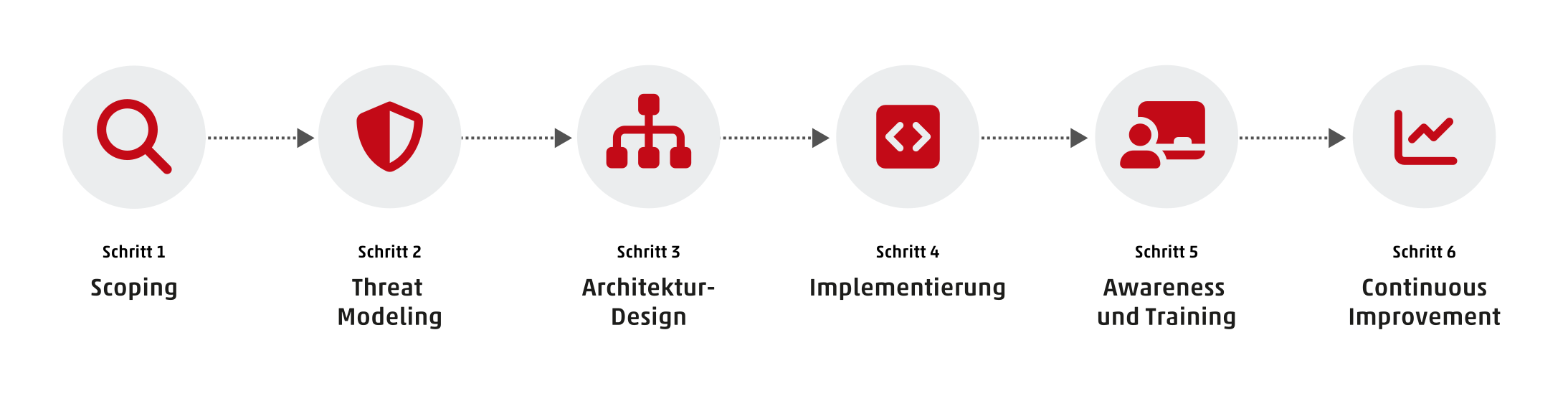
AI Security by Materna in 6 steps: structured, scalable and sustainable

AI Security is an ongoing process. We support your organisation step by step, from the initial analysis through to continuous improvement.

  1. Scoping: Identification of AI use cases and risks
  2. Threat modelling: Identification of potential attack vectors
  3. Architecture design: Integration of protection mechanisms and safeguards
  4. Implementation: Introduction of technical security measures
  5. Awareness and training: embedding knowledge and reinforcing behaviour
  6. Continuous Improvement: Regular testing and updates

Materna’s structured approach creates transparency, reduces risks and permanently embeds AI security within your organisation.

Security analysts and AI: the fight against hackers

AI helps security teams detect attacks more quickly and assess them with greater precision. Using AI-powered analysis tools and security platforms, Materna detects threats in real time, analyses data patterns and automatically prioritises incidents. This creates a hybrid defence: human expertise meets machine precision – for maximum response speed in an emergency.

Please feel free to contact us

Portrait von Ansprechpartner Robert Stricker

Robert Stricker
Abteilungsleiter Security Consulting